




Honing vs sharpening
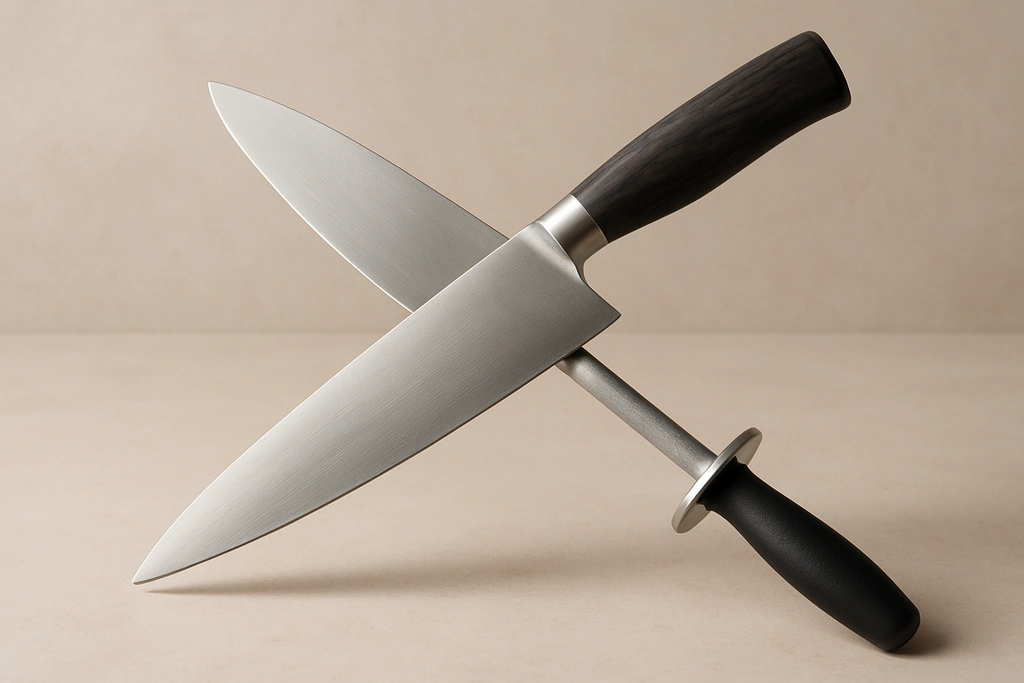
| Honing | Sharpening | |
|---|---|---|
| What it does | Realigns the edge | Removes metal to make a new edge |
| How often (Victorinox) | Before or after each cooking session | About once or twice a year, or after extensive use |
| Tool | Honing steel; Victorinox angle is 20 degrees, 5 strokes per side | Whetstone, manual or electric sharpener |
Victorinox's sharpening page. Honing angle is the steel angle, not the knife's sharpening angle.
Pick your angle and grit
| Maker | Angle per side | Source |
|---|---|---|
| Wusthof standard blades | 14 degrees | Wusthof |
| Wusthof Asian-style blades (Santoku, Nakiri) | 10 degrees | Wusthof |
| MAC | 15 degrees | MAC |
| Global | 15 degrees | Global |
Only angles a maker states. See the full knife sharpening angle chart. Grit: Made In starts at 800 to 1,000 and finishes at 3,000 to 5,000 for Western blades or 8,000 to 12,000 for Japanese blades.
How to sharpen a knife on a whetstone
Prepare the stone
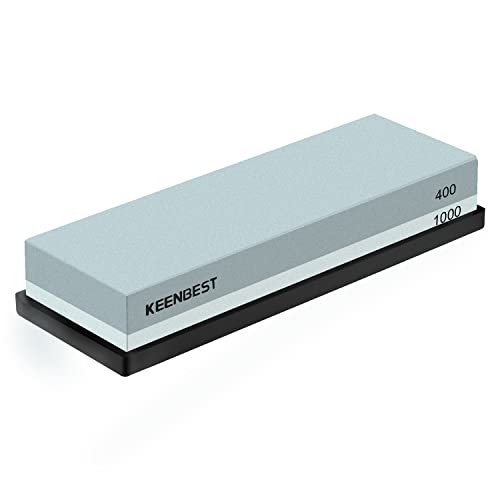
Water stones need to soak 10 to 45 minutes (Made In); Wusthof says about 10 minutes. Set it on a damp towel or non-slip mat, coarse side up.
Set the angle
Match your knife's bevel. Wusthof: 14 degrees for standard blades. Hold it steady with a guide or a steady wrist.
Draw the blade across the stone
Slide from heel to tip with even pressure, 10 to 20 times, until a small burr or steel fold forms along the edge (Made In).
Flip and repeat
Same number of strokes on the other side.
Move to the fine side
Repeat the motion on the finer grit to polish the edge and remove remaining steel (Wusthof).
Rinse, dry and hone
Rinse in hot water, dry right away, then use a honing steel.
Test the edge
Made In suggests slicing a tomato or a sheet of paper; a sharp blade cuts through with minimal effort. If it drags or skates, repeat on the coarse side until the burr forms again.
Cut safety
Victorinox notes that a blunt blade is more likely to slip and cause injury, and that sharpening takes care and focus. Work on a stable surface (a folded damp towel under a honing steel tip helps), keep your fingers behind the edge and away from the blade's path, and never test an edge with a fingertip.
Mistakes to avoid
| Mistake | Result | Fix |
|---|---|---|
| Changing angle mid-stroke | Rounded edge | Use a guide and keep the wrist still |
| Pressing hard | Gouged stone, uneven edge | Light, even pressure (Made In) |
| Stopping before a burr forms | Dull edge remains | Continue until you feel the burr |
| Letting the stone dry out | Clogs and drags | Keep it wet (Wusthof, Made In) |
When to use a sharpener instead
Pull-through and electric sharpeners set the angle for you, which is easier but removes more metal. Victorinox lists stones, manual sharpeners and electric sharpeners as options. If you own Japanese or specialty knives, check the maker's page for their stated angle before using a fixed-angle tool.
Sources: Wusthof: how to sharpen; Made In: how to use a sharpening stone; Victorinox: sharpen and hone. Checked November 15, 2026.