Kitchen tool
Recipe scaler
Lines that start with an amount are scaled. Lines without one ("salt to taste") are left exactly as written. Switch on grams and any cup, tablespoon or teaspoon line for an ingredient in our data is converted to grams.
Kitchen gear on Amazon
SponsoredAs an Amazon Associate, KitchenProds earns from qualifying purchases. See our affiliate disclosure.
Thickened Heavy-Duty 26pcs Stainless Steel Bowl, Mixing Bowl Set with Lid, Grater Attachment, Non-Slip Bottom and Kitchen Gadget Set, Sizes 7, 4, 2.5, 2.0, 1.5, 1QT, Ideal for Mixing and Serving
$45.99$35.98
View on Amazon (Thickened Heavy-Duty 26pcs Stainless Steel Bowl, Mixing Bowl Set with Lid, Grater Attachment, Non-Slip Bottom and Kitchen Gadget Set, Sizes 7, 4, 2.5, 2.0, 1.5, 1QT, Ideal for Mixing and Serving)Measuring Spoons, 6-Piece Heavy Duty Stainless Steel Measuring Spoons Set | Small Tablespoon with Metric and US Measurements, Set of 6 for Measuring Dry and Liquid Ingredients
$13.99$5.99
View on Amazon (Measuring Spoons, 6-Piece Heavy Duty Stainless Steel Measuring Spoons Set | Small Tablespoon with Metric and US Measurements, Set of 6 for Measuring Dry and Liquid Ingredients)Cuisinart 3-Piece Stainless Steel Mixing Bowl Set with Lids, CTG-00-SMB | 1.5, 3 and 5 qt. bowls with matching lids, nesting storage, refrigerator, freezer and dishwasher safe
$39.99$27.95
View on Amazon (Cuisinart 3-Piece Stainless Steel Mixing Bowl Set with Lids, CTG-00-SMB | 1.5, 3 and 5 qt. bowls with matching lids, nesting storage, refrigerator, freezer and dishwasher safe)Mik-Nana Food Scale, 10kg/22lb Digital Kitchen Scale Weight Grams and Ounces for Baking Cooking Coffee Package Postage, 6 Units with Tare Function, LCD Display, Easy Clean Stainless Steel
$9.98$8.06
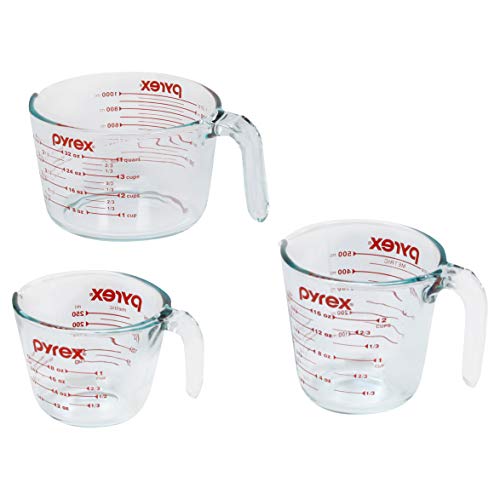
View on Amazon (Mik-Nana Food Scale, 10kg/22lb Digital Kitchen Scale Weight Grams and Ounces for Baking Cooking Coffee Package Postage, 6 Units with Tare Function, LCD Display, Easy Clean Stainless Steel)Pyrex Essentials (3-Pack) Glass Measuring Cups Set (1, 2 & 4 Cup) | For prepping, baking and cooking, preheated oven, dishwasher, freezer, and microwave safe
$25.99$19.99
View on Amazon (Pyrex Essentials (3-Pack) Glass Measuring Cups Set (1, 2 & 4 Cup) | For prepping, baking and cooking, preheated oven, dishwasher, freezer, and microwave safe)Rubbermaid Commercial Products Stainless Steel Oven Monitoring Thermometer | Safe for Inside Oven/Grill/Smoker, 60-580 Degrees F Range, Easy to Read Food Thermometer For Food Restaurant/Home Cooking
$10.85$9.22
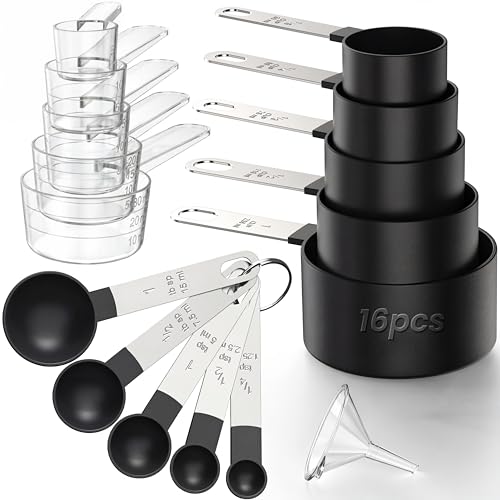
View on Amazon (Rubbermaid Commercial Products Stainless Steel Oven Monitoring Thermometer | Safe for Inside Oven/Grill/Smoker, 60-580 Degrees F Range, Easy to Read Food Thermometer For Food Restaurant/Home Cooking)TILUCK Stainless Steel Measuring Cups & Spoons Set, Cups and Spoons | Stainless Steel Nesting Measure Cups , Kitchen Gadgets for Cooking & Baking (10)
$15.99
View on Amazon (TILUCK Stainless Steel Measuring Cups & Spoons Set, Cups and Spoons | Stainless Steel Nesting Measure Cups , Kitchen Gadgets for Cooking & Baking (10))Spring Chef Stainless Steel Magnetic Measuring Spoons Set of 8, Black | Dual Sided Metal Teaspoon & Tablespoon Measuring Spoons with Leveler for Dry & Liquid Ingredients, Nesting, Dishwasher Safe
$9.99
View on Amazon (Spring Chef Stainless Steel Magnetic Measuring Spoons Set of 8, Black | Dual Sided Metal Teaspoon & Tablespoon Measuring Spoons with Leveler for Dry & Liquid Ingredients, Nesting, Dishwasher Safe)Etekcity Food Kitchen Scale, Digital Grams and Ounces, 11lb | Tare function, ideal for baking, weight loss, keto, meal prep, packages, liquids and jewelry, 304 Stainless Steel
$13.99
View on Amazon (Etekcity Food Kitchen Scale, Digital Grams and Ounces, 11lb | Tare function, ideal for baking, weight loss, keto, meal prep, packages, liquids and jewelry, 304 Stainless Steel)




Prices and availability were accurate when retrieved from Amazon and may change. Retrieved Nov 15, 2026.
Quick answer
Paste one ingredient per line, type how many servings the recipe makes and how many you want, and each amount is multiplied and tidied: 48 teaspoons becomes 1 cup, 8 tablespoons becomes 1/2 cup.
Scale a recipe
Scaled by 1.5
- 3 cups all-purpose flour
- 2 1/4 tsp baking powder
- 3/4 tsp salt
- 1 cup + 2 tbsp butter
- 1 1/2 cups sugar
- 3 eggs
- 1 1/2 tsp vanilla extract
- salt for the pan
Baking in a different pan? Work out the multiplier with the baking pan size converter, then enter it as the new servings.
What the scaler does to each line
It reads the leading amount (whole numbers, decimals, fractions, mixed numbers and characters such as ½), looks for a unit, then multiplies. Teaspoons, tablespoons and cups are added up in teaspoons and written back in the largest unit that gives a clean fraction, so scaling 1 tsp by 12 gives 1/4 cup rather than 12 tsp.
Ingredient names are matched to the data set by name or common alias; a bare flour is read as all-purpose flour and a bare sugar as granulated sugar. Ounces, pounds, grams and millilitres are multiplied and rounded. A count such as 2 eggs is multiplied too; if the result is not a whole number the tool flags the line so you can decide what half an egg means in your recipe.
Example: the sample recipe made 3 times as big
Produced by the same code that runs in the tool. The grams column uses this site's ingredient weights.
| Original | Times 3 | Times 3 in grams |
|---|---|---|
| 2 cups all-purpose flour | 6 cups all-purpose flour | 750 g all-purpose flour |
| 1 1/2 tsp baking powder | 1 1/2 tbsp baking powder | 21 g baking powder |
| 1/2 tsp salt | 1 1/2 tsp salt | 9 g salt |
| 3/4 cup butter | 2 1/4 cups butter | 511 g butter |
| 1 cup sugar | 3 cups sugar | 600 g sugar |
| 2 eggs | 6 eggs | 6 eggs |
| 1 tsp vanilla extract | 1 tbsp vanilla extract | 13 g vanilla extract |
| salt for the pan | salt for the pan | salt for the pan |
What scaling cannot fix
Amounts scale in a straight line; cooking does not. A bigger batch needs a different pan, which changes depth and bake time, and liquid reduces differently in a wider pot. Spices, salt and raising agents are easiest to over-do when multiplying, so add them in steps and taste or test as you go. Treat the oven time as a starting point and check early.
Frequently asked questions
Does the recipe scaler handle fractions like 1/3 and 2 1/4?
Yes, along with decimals and characters such as ½ and ¾. The scaled result is written back as a kitchen fraction.
What happens to a line with no amount?
It is copied unchanged and marked, so "salt to taste" or "oil for the pan" stay as they are.
Can I make a recipe smaller than the original?
Yes. Enter a smaller number in the new servings box. Halving 1 egg gives a flagged half, which is worth beating and measuring by volume instead.
More kitchen tools
- Cups to gramsPick an ingredient and an amount, get grams and ounces.
- Grams to cupsStart from the scale reading and get cups, tablespoons and teaspoons.
- Kitchen conversion chartVolume converter, butter sticks, oven temperatures. Print it.
- Air fryer converterOven temperature and time in, an air fryer starting point out.
- Baking pan size converterSwap one pan for another and get the scale factor.