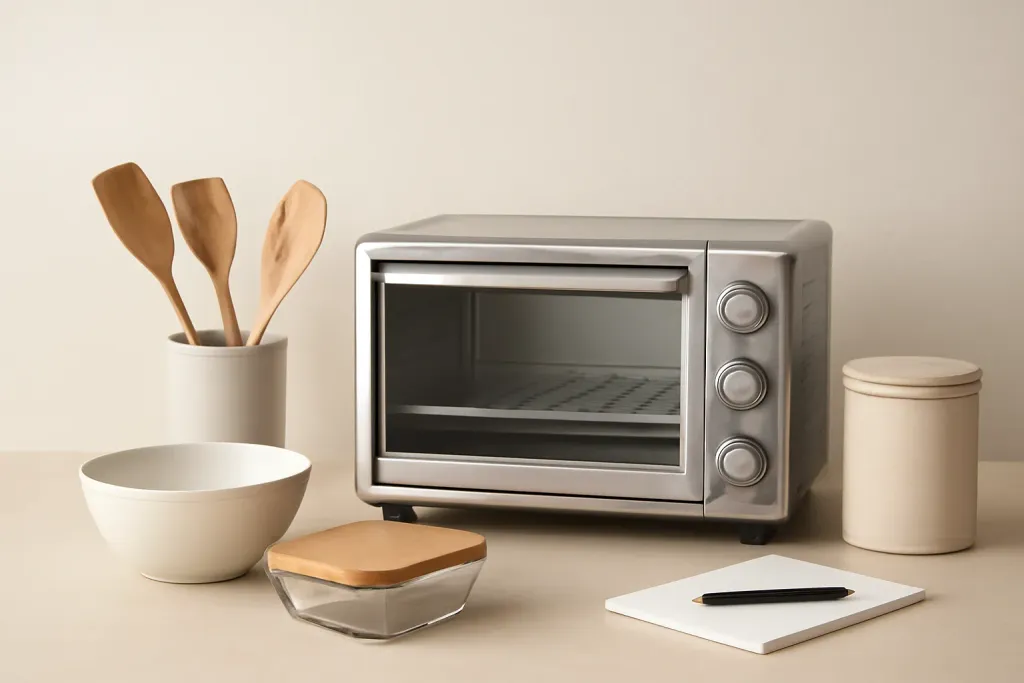
Toaster Oven Size Basics
The phrase toaster oven size and capacity guide refers to two different things: the appliance’s outside footprint and the amount of usable space inside. Both matter when you shop. A compact toaster oven may save counter space, but it can limit the pans and foods you can use. A larger model may be more flexible, yet it can also need more clearance and storage space.
Manufacturers often describe toaster oven size with outside dimensions, internal cavity measurements, and shorthand labels such as “4-slice,” “6-slice,” or “12-inch pizza.” Those labels are useful as a starting point, but they are not standardized. Real usable space depends on rack position, door design, heating element placement, and how much room a dish needs to sit safely inside the cavity.
The most practical approach is to think about what will sit on the counter, what cookware you already own, and how often you cook for one person versus several. That context makes comparisons easier and keeps you from relying on marketing shorthand alone. It also helps separate toast capacity from true cooking capacity. An oven may handle several slices of bread and still be too small for a casserole dish or a small baking pan.
If you want a versatile countertop oven, focus on the interior dimensions and the included accessories rather than only the slice count on the box. That usually gives a clearer picture of what the appliance can handle in everyday use.
How Capacity Is Measured
Capacity is usually described in one or more of these ways: number of toast slices, pizza diameter, interior cubic space, or the size of pans that fit inside. Each measure tells you something different, and none fully explains real-world use on its own.
Toast-slice labels can be misleading because bread thickness varies and oversized slices may not fit as neatly as standard sandwich bread. Pizza-size labels are also approximate. A toaster oven described as fitting a 12-inch pizza may do so only under specific conditions, such as placing the pizza directly on a rack rather than on a pan. Interior cubic measurements are more technical, but they are not always easy to translate into everyday cooking tasks.
For many households, pan compatibility is the most useful measurement. If a toaster oven accepts a standard baking dish, a loaf pan, or a small sheet pan, it may support more flexible cooking than a smaller unit that only fits the included crumb tray or a very narrow pan. Even then, rack clearance matters. A dish may fit in the cavity but sit too close to the top heating element to be practical.
When comparing products, look for the maximum internal width, depth, and height, plus any limitations noted in the manual or product listing. Those numbers help you judge whether the oven suits everyday tasks like reheating leftovers, roasting vegetables, or baking a small batch of cookies.
Match Size to Household Needs
Household size is one of the clearest ways to narrow down toaster oven capacity. A single person or couple often does well with a compact model, especially if the appliance will mainly handle toast, bagels, open-face sandwiches, and small reheats. These units are usually easier to fit on crowded counters and may be more convenient to store when not in use.
For a family, a mid-size or larger toaster oven may be more practical. More internal space can make it easier to cook several portions at once, which may reduce the need to run the oven multiple times. Still, a bigger cavity only helps if it fits the dishes you actually use. A large footprint is not worthwhile if it crowds the sink, blocks cabinets, or makes daily access awkward.
Think about how you cook, not just how many people live in the home. Someone who frequently warms leftovers or small frozen items may prefer a smaller footprint. Someone who wants to roast vegetables, bake side dishes, or heat mixed meals may benefit from extra height and rack flexibility. In that case, room for both air circulation and dish clearance can matter more than a simple slice count.
Future needs are worth considering too. If your household regularly changes size because of guests, school schedules, or shared meals, choosing a slightly more generous capacity may be more practical than buying the smallest model that seems sufficient today.
Countertop Footprint and Clearance
The outside dimensions of a toaster oven matter as much as the cooking cavity, especially in kitchens where counter space is limited. Before choosing a model, measure the area where it will sit, including room for the door to open fully and for you to slide pans in and out comfortably.
Clearance is another important detail. Toaster ovens release heat from the sides, back, top, and sometimes through vents at the rear or underside. A model may technically fit between cabinets and a wall, yet still need extra space around it for regular use and to avoid crowding nearby items. The user manual usually lists minimum clearance recommendations, and those should be treated as the baseline rather than a suggestion.
Vertical clearance matters as well. Some toaster ovens have doors that open downward and may extend into drawer space or interfere with shelves. Others place controls on top, which can require additional overhead room. If you keep paper goods, oils, or spice racks nearby, make sure they are not positioned where heat could build up.
Storage is part of the decision too. If the appliance will be put away after use, check whether its weight and shape make that realistic. A compact toaster oven may be easier to lift onto a shelf, while a larger model is often best left on the counter full-time. The right size is the one you can use comfortably every day, not just the one with the biggest advertised capacity.
Browse our recommended products
Our featured picks refresh periodically. While we update them, our editorial guides can help you find the right pick.
See our guidesCookware and Accessory Fit
A useful capacity guide should include cookware, because an oven’s value depends on what fits inside it. Many shoppers want to know whether a toaster oven can handle a standard baking dish, a loaf pan, or a small sheet pan. Those questions are more helpful than broad capacity labels because they connect directly to the foods you prepare.
Before buying, compare the internal cavity measurements with your most-used pans. Pay attention to rim height, handle width, and the space needed to remove a hot dish without touching the door or heating elements. A pan that fits in theory may still be awkward if there is not enough room to grasp it safely.
Accessory bundles can also affect usable capacity. Some models include a rack, crumb tray, and baking pan sized for the appliance. These accessories can simplify setup, but they should not replace a check of the interior dimensions. A supplied pan may be shallower or smaller than the cookware you normally use.
If you plan to use the toaster oven for more than toast, confirm whether it offers several rack positions. Adjustable racks can make it easier to cook thin items, such as melted cheese on bread, and taller items, such as small casseroles or roasted vegetables. That flexibility often matters more than a single headline capacity number.
Common Size Categories
Toaster ovens are often grouped into compact, medium, and large categories. These labels are not universal, but they can still help when used carefully. Compact models are usually best for basic tasks and small kitchens. Medium models often balance footprint and flexibility. Large models may suit cooks who want more room for baking dishes or multiple portions.
Compact units typically appeal to people who prioritize counter space and simple reheating. They may be easier to move and store, but the tradeoff is a smaller internal cavity. Medium-sized toaster ovens often offer a useful middle ground, with enough room for a wider range of cookware while still remaining manageable on most counters.
Large toaster ovens can be more versatile, especially when they offer several rack positions and enough height for larger items. However, bigger does not automatically mean better. A large cavity can be inefficient for small jobs if you mostly make toast or reheat single servings. It may also take more time to preheat simply because there is more empty space inside.
When browsing categories, read beyond the size label. Look for exact dimensions, rack layout, and the types of pans the appliance claims to fit. Those details give a more reliable picture of how the oven may function in your kitchen than a generic “large capacity” description.
Shopping Checklist Before You Buy
A careful checklist can help you compare toaster oven size and capacity guide options without relying on vague product naming. Start with your available counter space, then confirm the appliance’s width, depth, and height. Next, check the door swing and any required clearance around the unit.
After that, match the interior dimensions to your cookware. Make a short list of the pans and dishes you use most often, such as a small baking sheet, loaf pan, or casserole dish. If a model cannot fit the items you actually use, its extra capacity may not matter much.
It is also worth reviewing the control layout. Some larger toaster ovens place knobs or buttons in ways that may reduce usable top space or make the appliance taller than expected. Small design choices can affect placement on a crowded counter.
Finally, think about cleaning. A removable crumb tray and an interior that is easy to wipe can improve day-to-day convenience. Cleaning ease does not change capacity, but it does affect whether the appliance feels practical enough to use often. A toaster oven that fits your space, cookware, and routine is usually the better everyday choice.
Final Takeaway
The best way to use a toaster oven size and capacity guide is to focus on real kitchen needs rather than broad marketing labels. Start with countertop space, then compare internal dimensions, rack positions, and cookware fit. A model that matches your daily tasks is usually more useful than one that simply advertises a bigger number.
If your needs are basic, a compact toaster oven may be enough. If you cook for more people or want more flexibility with pans and dishes, a medium or large model may be the better fit. Either way, the key is to verify what will actually fit inside and around the appliance before you buy.
That approach keeps expectations realistic and makes it easier to choose a toaster oven that works with your kitchen instead of competing with it. When the footprint, clearance, and internal space align, the appliance is more likely to feel convenient from the first day of use.