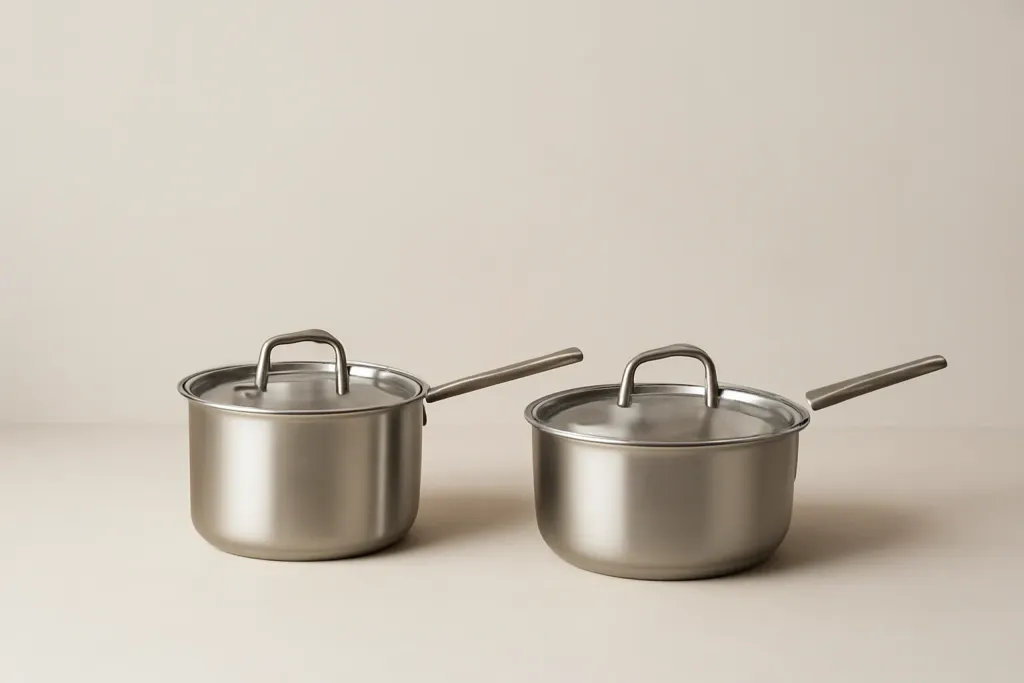
Saucepan vs Saucier: the basic difference
When comparing saucepan vs saucier, the easiest way to think about it is shape. A saucepan has straight or nearly straight sides and a flat bottom, while a saucier has rounded sides that curve smoothly from the base up to the rim. That one design difference changes how each pan handles stirring, evaporation, and access to the corners of the cooking vessel.
For many home cooks, a saucepan is the more familiar all-purpose pot. It is commonly used for boiling small batches of pasta, reheating soups, making rice, simmering vegetables, and cooking grains. A saucier is more specialized, but it is not limited to restaurant kitchens. Its curved shape is useful for sauces, custards, gravies, risotto, and any recipe where you want a spoon or whisk to move smoothly across the pan without catching on corners.
Neither pan is universally better. The right choice depends on what you cook most often. If you want a straightforward workhorse for everyday tasks, a saucepan usually makes sense. If you often stir delicate mixtures, reduce liquids, or work with recipes that benefit from constant motion, a saucier can be the more comfortable tool.
How shape changes cooking behavior
The difference between these pans is not just visual. Straight sides and rounded sides affect how heat and ingredients behave during cooking. A saucepan’s upright walls help contain larger volumes and can reduce splashing when you bring water or broth to a boil. Its shape also makes it easier to measure liquids and transfer contents with a ladle.
A saucier’s curved interior gives a spoon, spatula, or whisk a continuous path along the bottom and sides. That can be especially helpful when stirring thickened sauces or mixtures that tend to cling to edges. Because there are no sharp interior corners, food is easier to gather into the center, which can make it simpler to control texture and prevent buildup in the pan.
The lower, wider profile of many sauciers can also encourage faster evaporation than a taller saucepan of similar diameter, though the exact result depends on the pan size and the recipe. For cooks who often reduce liquids or want more surface area for stirring, that shape can be an advantage. For tasks that benefit from holding more liquid in a smaller footprint, the saucepan remains more practical.
Best uses for a saucepan
A saucepan is the classic general-purpose pot for the home kitchen. Its straight sides and manageable footprint make it well suited to a wide range of routine tasks. Many cooks reach for it when they need to heat water for tea, cook boxed or homemade grains, warm canned or leftover soups, or make a quick pan sauce in modest quantity.
It is also useful when you need a pan that can comfortably hold liquid without feeling overly broad. That makes it a good choice for simmering beans, preparing oatmeal, or cooking vegetables in water or broth. Because the walls rise vertically, a saucepan can feel efficient for recipes that need depth more than wide surface area.
In practical terms, if you only want one small to medium pot, a saucepan is usually the safer starting point. It handles a broad range of everyday cooking tasks and fits naturally into most pantry-to-stovetop workflows. For many households, it is the default pan that sees the most use.
Best uses for a saucier are a little different. This pan is especially handy for custards, risotto, caramel sauces, reductions, gravy, polenta, and other recipes that require steady stirring. The rounded sides make it easier to work a whisk through the entire cooking surface. That can matter when you are trying to keep ingredients moving evenly across heat.
A saucier can also be appealing for recipes that start with a sautéed base and then transition into a finished sauce. The shape supports constant scraping and folding, which can help with texture control. If you often cook in smaller batches and prioritize stir-friendly design, the saucier becomes more compelling.
Which pan is more versatile?
For most kitchens, the saucepan is the more versatile option simply because it matches more common cooking jobs. It can do almost everything a saucier can do, though not always as comfortably. If a recipe calls for simmering, boiling, heating, or holding liquid, a saucepan usually performs the task without issue.
That said, versatility is not only about the number of dishes a pan can make. It is also about comfort and efficiency. A saucier may be the better everyday tool for cooks who spend more time making sauces, custards, or reduced pan liquids. In those situations, the shape can make stirring easier and help ingredients move more predictably.
If you are deciding between the two and can buy only one, ask how you actually cook. If your kitchen leans toward soups, grains, reheating, and simple boiling, choose the saucepan. If your cooking style is more sauce-driven and you value a pan that is easy to whisk in, choose the saucier. Some cooks eventually keep both because they serve different needs rather than overlapping perfectly.
Browse our recommended products
Our featured picks refresh periodically. While we update them, our editorial guides can help you find the right pick.
See our guidesMaterials and construction to compare
When shopping for a saucepan vs saucier, shape matters, but construction matters too. Common materials include stainless steel, aluminum, and clad combinations. Each has tradeoffs in weight, heat response, and cleanup. Because this article is about the pan types rather than a specific product, it is better to focus on design features that affect everyday use.
Look for a base that sits flat and feels stable on your cooktop. A pan that wobbles or rocks is more difficult to manage, especially when it is full of liquid. Handles should feel secure and offer enough clearance for your grip. Helper handles can be useful on larger pans, though many small sauciers do not need them.
Lids are another practical consideration. A well-fitting lid helps control evaporation when you need it, particularly in a saucepan used for grains, rice, or simmered dishes. Some sauciers are sold without lids, while others include them. If you expect to use the pan for more than sauces, a lid can add flexibility.
Capacity matters as well. A saucepan is often chosen in a size that matches common household portions, while a saucier may be selected for a more specific range of sauce-making tasks. Be cautious about choosing a pan based only on appearance. The right size and weight for your stove, storage, and cooking style can matter more than the label on the box.
Ease of stirring, whisking, and scraping
One of the strongest arguments for a saucier is how naturally it supports whisking. The curved interior lets a whisk follow the shape of the pan without meeting a corner. That can make it easier to keep a sauce moving as it thickens, or to smooth out a custard base with fewer interruptions. It is also convenient when you want to scrape down the sides while cooking.
A saucepan is still perfectly usable for stirring, but the straight sides create a different motion. A spoon or whisk may need a little more angle adjustment to reach the lower edge where the side meets the bottom. For many recipes, that is not a problem. But when the mixture is sticky, delicate, or prone to sticking, the saucier design can feel more forgiving.
Control also depends on how much attention a recipe requires. If you are heating something that can sit for a few minutes with occasional stirring, a saucepan is usually enough. If the dish needs continuous movement, a saucier offers a more natural workflow. That is why cooks often associate the saucier with precision tasks even though it is not a specialty pan in the same sense as a niche tool.
How to choose between saucepan and saucier
Start with the recipes you cook most often. If your weeknight routine includes boiling water, simmering soups, cooking rice, and reheating leftovers, the saucepan is the easy pick. Its shape is familiar, practical, and broadly useful. For many shoppers, it becomes the first pot they reach for because it fits so many kitchen tasks.
If you spend more time making sauces from scratch, finishing pan gravies, or working with ingredients that require frequent whisking, the saucier deserves attention. It can feel more responsive and less awkward during stirring. For cooks who value precision over capacity, the shape may matter more than the larger market reputation of a standard saucepan.
Storage and cooktop space also play a role. Taller saucepans may be easier to stack or fit into a cabinet, while wider sauciers can offer better access but take up more shelf room. Consider your stove size, your usual batch sizes, and whether you prefer a pan that is easy to pour from. These everyday details often matter more than terminology.
A simple rule helps: choose a saucepan for broad utility, and choose a saucier for more refined stirring and sauce work. If you are still undecided, a medium saucepan is generally the safer first purchase because it covers the widest range of cooking tasks without much compromise.
Bottom line for home cooks
In the saucepan vs saucier comparison, neither pan replaces the other perfectly. A saucepan is the practical all-rounder: deeper sides, more common in everyday kitchens, and well suited to boiling, simmering, and general heating. A saucier is the shape-forward option: rounded sides, easier whisking, and better control for sauces and delicate mixtures.
If your kitchen needs one dependable small pot, the saucepan usually wins on flexibility. If your cooking leans toward sauce-making and stirred dishes, the saucier may feel like a better fit. Many home cooks eventually appreciate both, but you do not need both to cook well.
The best choice is the one that matches your recipes, your stovetop, and the way you like to move through a dish. When in doubt, think less about specialty labels and more about how the pan will feel in daily use. That approach leads to a purchase you are more likely to use often.