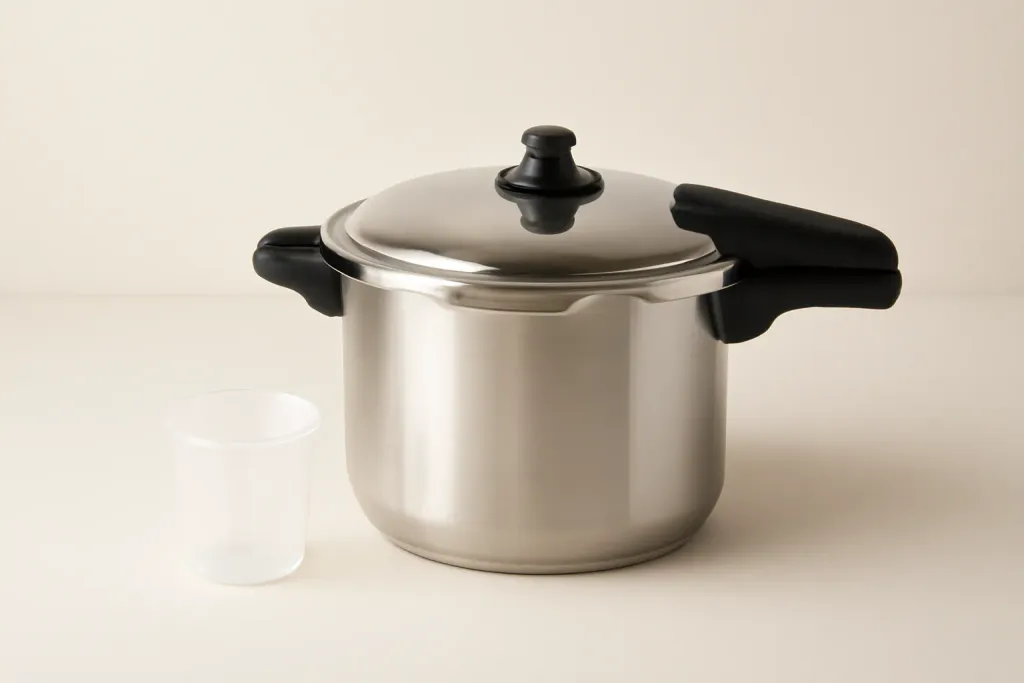
How Pressure Cooker Size Is Measured
In a pressure cooker size guide, size usually refers to quart capacity, not the amount of food you should actually cook in the pot. A 6-quart cooker does not mean you should plan to fill all 6 quarts with ingredients. Pressure cookers need headspace so steam can build and food has room to expand.
Manufacturers may list total capacity, but that number is only the starting point. The practical cooking capacity is often lower because many recipes require room for liquid, ingredients, and steam circulation. That is why a pot labeled 6 quarts can feel more like a comfortable 4- to 5-quart working space for many everyday meals.
It also helps to separate capacity from cookware shape. Two pressure cookers with the same quart rating can still feel different inside if one is taller, wider, or shaped differently. Interior dimensions matter when you cook whole vegetables, bone-in cuts, stacked ingredients, or dishes with plenty of liquid.
The main idea is simple: the quart number tells you the general size class, but it does not tell you how much of your recipe the cooker can comfortably handle. That distinction is the foundation of choosing well.
Common Sizes and Who They Fit
Pressure cookers are commonly sold in a few standard sizes, and each one tends to suit a different kind of kitchen. A pressure cooker size guide is most useful when it connects those sizes to real-world use instead of treating quart ratings as abstract numbers.
2 to 3 quarts: Best for very small households, side dishes, rice, or small batches. These compact models can be useful, but they are limited as all-purpose cookers.
4 quarts: Often a good fit for one or two people, especially if you cook smaller recipes or want a cooker for grains, vegetables, and sauces.
6 quarts: A common middle ground for many households. It usually offers enough room for family meals, meal prep, and a wide range of standard recipes.
8 quarts: Better for larger families, batch cooking, or recipes that need more room. It can also be helpful if you regularly want leftovers.
10 quarts and above: Usually chosen for high-volume cooking or frequent batch prep. These sizes are more specialized and can be cumbersome for everyday use.
If you are deciding between two sizes, it often makes sense to prioritize the one that fits your most common meals. A cooker that works smoothly most of the time is more useful than one sized only for an occasional large recipe.
Choose by Household and Portion Size
The number of people you cook for is a practical starting point, but it should not be your only consideration. Two households with the same headcount may have very different routines. One may cook quick weeknight dinners, while another prefers soups, stews, roasts, or large meal-prep batches.
For one person, a 3- to 4-quart pressure cooker is often enough if the goal is simple dinners or smaller portions. For two people, a 4- to 6-quart size usually adds flexibility, especially if leftovers are welcome. For three or four people, many buyers land on a 6-quart model because it balances everyday convenience with enough room for larger recipes.
For five or more people, or for households that regularly cook in bulk, an 8-quart model may be more practical. It can reduce the need to split recipes into multiple batches, though it will also take up more storage space.
Portion size matters as much as headcount. If you usually make a single protein with a side, a smaller pot may be enough. If you cook stews, chili, beans, or bone-in dishes that expand or require extra liquid, a larger cooker may be easier to use. Thinking in terms of your regular recipe volume is often more helpful than focusing only on household size.
Match Size to the Recipes You Cook Most
The best size depends heavily on the kinds of foods you make most often. Some foods stay compact, while others expand, foam, or need room for liquid and stirring. A practical pressure cooker size guide should connect capacity to the recipes you actually use.
Rice and grains: Smaller cookers can work well for side portions, but larger batches usually call for a 6-quart model or bigger.
Beans and lentils: These often benefit from more room because they expand and can create foam during cooking.
Soups and stews: A 6-quart size is often a comfortable middle ground, while 8 quarts may suit bigger batches.
Meats and roasts: Larger cuts may fit more easily in an 8-quart cooker, especially if you want space for liquid and aromatics around the food.
Vegetables and sides: These can often be handled in smaller models, particularly for one- or two-person households.
Recipe volume is not always obvious from the ingredient list. Broths, sauces, beans, and mixed ingredients can occupy more space than expected once combined. If your cooking style tends to be generous, a slightly larger cooker can be easier to manage than a tight fit.
Browse our recommended products
Our featured picks refresh periodically. While we update them, our editorial guides can help you find the right pick.
See our guidesElectric vs. Stovetop Size Considerations
Electric and stovetop pressure cookers are both sold by capacity, but they do not always feel the same in use. Electric models often have a larger exterior footprint because the heating element, control panel, and outer housing add bulk. That means a 6-quart electric cooker may take up more counter or cabinet space than a 6-quart stovetop model.
Stovetop pressure cookers usually have a simpler shape and may be easier to store. They still need room for handles, the lid, and safety components, but they often fit more easily into a standard cookware cabinet.
Usable interior space can also vary by design. Some electric models are rounder or taller inside, while stovetop models may have straighter sides. This does not make one style better in every case, but it does affect how comfortably larger ingredients fit. If you often cook whole chickens, bulky vegetables, or stacked ingredients, interior shape can matter nearly as much as the quart number.
When comparing styles, it helps to look beyond the headline capacity. Check the interior dimensions, the overall footprint, and where the cooker will live when not in use. That gives you a clearer picture of how the size will work in your kitchen.
Storage, Counter Space, and Ease of Use
Size affects more than recipe capacity. It also affects how easy the pressure cooker is to store, lift, and clean. A compact model may be easier to move in and out of a cabinet, while a larger one can feel bulky in smaller kitchens or tighter storage spaces.
If you plan to keep the cooker on the counter, measure the footprint carefully. Electric models need enough room for the lid to open and for steam release access during use. Stovetop models are often easier to tuck away, but the pot, lid, and handles still need shelf space.
Weight matters too, especially if you cook with a full pot of liquid. A larger cooker can be harder to lift and move when it is filled, which is worth considering for cleaning and serving. The most convenient size is not just the one that fits your recipes; it is also the one you can comfortably handle in everyday use.
If a cooker feels too large, some people use it less often even if it technically works for their food. For many shoppers, the better choice is the model that is large enough for occasional bigger meals but still manageable on a weeknight. Convenience is part of the sizing decision, not a separate issue.
Safety and Fill-Level Basics
Pressure cookers depend on steam, so respecting fill limits is essential. No matter what size you choose, the pot needs enough space for pressure to build and for ingredients to expand. Overfilling can lead to messy results and may interfere with proper cooking, so always follow the manufacturer’s instructions for your specific model.
Different foods behave differently in the pot. Soups, beans, grains, and foamy ingredients often need more headspace than denser foods. A recipe may look modest at first, yet still rise or expand during cooking. That is one reason many home cooks prefer a little extra capacity rather than the smallest size that technically fits a recipe.
It is important not to assume the full quart rating is the amount you should use for every dish. The quart number describes total capacity, not the everyday fill level. If you are unsure, the manufacturer’s manual and the recipe instructions should guide the final decision.
Size is only one part of safe use, but it is an important one because a pot that is too small can make routine cooking less predictable. Choosing a comfortable margin of space can make the cooker easier to use within the guidance provided for that model.
How to Choose the Right Size With Confidence
The easiest way to use a pressure cooker size guide is to start with your actual habits. Ask what you cook most often, how many people you usually serve, and how much storage space you have. Then consider whether you prefer compact weeknight meals or larger batch cooking sessions.
A simple rule of thumb is this: if you mostly cook for one or two people, a 4-quart model may be enough. If you want one cooker that can handle many household needs, a 6-quart model is often the most balanced choice. If you regularly cook for a crowd or make large batches, 8 quarts or more may be more practical.
It can also help to think about future use. If your cooking routine may change, a little extra capacity can reduce the chance of outgrowing the cooker too soon. On the other hand, if you know you will mostly make smaller meals, an oversized pot may be less convenient day to day.
The most practical approach is to choose the smallest size that still comfortably handles your typical recipes with the needed headspace. That gives you flexibility without making the cooker awkward for everyday use. A well-matched pressure cooker should fit your kitchen, your recipes, and your storage space without creating constant compromises.