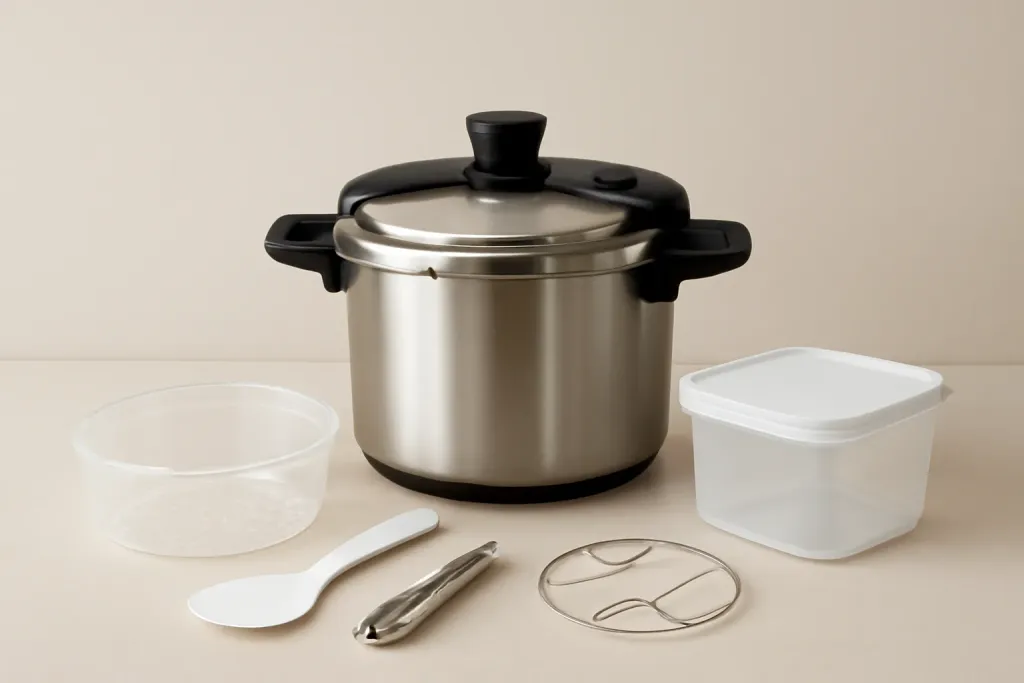
What This Guide Covers
This pressure cooker accessories guide is designed to help home cooks sort the genuinely useful add-ons from the clutter. Pressure cookers are already efficient on their own, but a few well-chosen accessories can make them easier to use, cleaner to maintain, and more flexible for everyday meals. The key is to focus on items that improve fit, convenience, and safe handling rather than gadgets that add complexity.
Because pressure cookers vary by brand, capacity, and design, the best accessory for one model may be a poor match for another. That is why this guide emphasizes compatibility, material quality, and simple use cases. It also stays conservative about safety: always follow the manufacturer’s instructions for your specific cooker and avoid any accessory that interferes with sealing, venting, or latch function.
For most shoppers, a good starting point is a short list of basics: a trivet or steamer rack, a compatible sealing ring if your model uses one, a safe way to remove hot inserts, and containers or molds sized to the cooker’s interior. After that, you can decide whether specialized accessories such as stackable pans, springform pans, or extra inner pots fit your cooking style.
Must-Have Accessories for Most Home Cooks
Some accessories are useful in so many situations that they deserve first consideration. A trivet or steamer rack is one of the most common. It lifts food or a heat-safe container above the liquid in the cooker, which is helpful for steaming vegetables, cooking eggs, preparing grains in a bowl, or keeping delicate foods from sitting directly in moisture. Many cookers include one, but if yours did not, a properly sized rack is a practical purchase.
A second basic item is a heat-safe sling or lifting strap. This is especially useful when you cook cheesecake, rice in a bowl, or covered dishes in a smaller pan. The sling helps you lower the container into the cooker and lift it back out without reaching into hot steam. Look for sturdy handles, a length that extends comfortably above the rim, and materials rated for high heat.
Extra sealing rings are another common need for cookers that use a removable gasket. Silicone rings can absorb odors over time, and many people prefer to keep separate rings for savory and sweet foods. If you buy one, make sure it is designed for your exact model and size. A loose or poorly matched ring can prevent proper sealing, so compatibility matters more than color or packaging.
An additional inner pot can also be worth considering if you use the cooker often. Having a spare makes it easier to prepare back-to-back recipes or cook a dish that needs a different insert from the one used for another meal. Stainless steel is common, but the most important factor is a precise fit inside your cooker, not the material alone.
Materials and Build Quality to Look For
Accessory material affects both function and convenience. For most pressure cooker accessories, stainless steel, food-grade silicone, and heavy-duty heat-resistant plastics are the most familiar options. Stainless steel is often favored for racks, steamer inserts, and pans because it is sturdy and easy to clean. Silicone is useful for seals, handles, sling components, and some baking tools because it can flex and tolerate heat. Heat-resistant plastics may appear in lids, baskets, and handles, but they should be used only where the manufacturer intends them for high-temperature contact.
Quality is usually visible in the details. A trivet with smooth welds and stable feet is less likely to wobble. A springform pan with a reliable latch and a snug base is more likely to support neat unmolding. A silicone ring should feel supple without being overly flimsy, and it should lie evenly in its groove. If an accessory has seams, handles, or locking mechanisms, check that they appear solid and are easy to operate with wet or gloved hands.
It is also wise to avoid accessories that are hard to clean in their narrowest spaces. Pressure cooking often leaves starch, oil, or sauce residue in corners and around seams. If an item looks attractive but has many hidden crevices, it may become inconvenient quickly. Simple construction often works best for everyday use.
Fit, Size, and Compatibility Basics
Fit is the most important factor in any pressure cooker accessories guide because an accessory that does not fit correctly can be useless or inconvenient. Start by checking the usable interior diameter and depth of your cooker, not just its advertised capacity. Two cookers with the same nominal size may still have different interior shapes, rim widths, or lid clearances.
For inserts, pans, and racks, measure the inside space carefully and leave room for steam circulation. A pan that fits too tightly may be difficult to remove and may reduce the flexibility of your cooking setup. At the same time, an accessory that is too small may tilt, shift, or waste capacity. Look for product descriptions that specify the internal dimensions they are meant to fit, and compare those figures with your cooker’s manual when possible.
Compatibility also includes the cooking style. A stackable insert system may be useful if you cook multiple foods at once, but only if the lid still closes properly and the setup leaves enough room for safe operation. A replacement gasket must match the exact model and size. Even a small mismatch can affect sealing. For brand-specific cookers, model compatibility is especially important, while some universal accessories work across several brands if their dimensions align.
If your cooker has a nonstick inner pot, check whether the accessory could scratch or stress the coating. For many users, stainless steel utensils and accessories are the safer choice around coated surfaces. When in doubt, use items recommended by the manufacturer or choose simpler accessories that avoid contact with delicate finishes.
Browse our recommended products
Our featured picks refresh periodically. While we update them, our editorial guides can help you find the right pick.
See our guidesAccessories That Help With Common Cooking Tasks
Different tasks call for different tools. For steaming vegetables, eggs, or fish, a rack or steamer basket is usually the most helpful accessory. It keeps food above the liquid and promotes even exposure to steam. If you often cook small items that might fall through a basket, consider a basket with fine enough openings or a pan that holds the food securely.
For cakes, custards, and similar dishes, springform pans and heat-safe baking molds are popular options. These can be useful when you want a set shape or need to unmold the food after cooking. The pan should fit with enough room around the sides for steam to circulate, and the latch should be easy to release without forcing it. A pan with a removable base can also help, provided it is designed for the cooker’s environment.
For rice, grains, and one-pot dishes, smaller heat-safe bowls or stainless inserts can be useful when you want to keep ingredients separate or avoid direct contact with the base. Some cooks also like stackable containers for preparing two components in one cook cycle. These can work well for simple meals, but only if they sit securely and do not block the lid or vent path.
If you prepare soups, sauces, or dishes with a lot of liquid, a ladle with a long handle, a heat-safe spoon, and a stable place to set hot lids can make the workflow easier. These are not specialized pressure-cooker products, but they support safer handling around steam and hot surfaces.
Safety and Usability Considerations
In a pressure cooker accessories guide, safety should come before convenience. Any accessory that touches the cooker should leave the sealing path, vent area, and locking mechanism unobstructed. Avoid improvised inserts, foil arrangements, or oversized pans that may interfere with how the lid closes. If an accessory makes the cooker harder to seal or open, it is not a good choice.
Also pay attention to heat management. Steam escapes quickly when the cooker is released, and accessories can be hot even after the pressure cycle ends. Use handles, slings, or tongs that let you keep your hands away from the opening. When you remove a pan or rack, ensure it has a secure grip and enough clearance to move straight up without scraping the sides.
Cleaning is part of usability too. Accessories that are dishwasher-safe may be convenient, but dishwasher-safe labeling should still be checked for the specific item. Silicone parts can pick up odor or residue if not cleaned carefully, while stainless steel may show spots if left damp. Drying accessories fully before storage can help keep them ready for the next use.
Finally, avoid accessories that promise to solve problems by changing how the cooker itself works. This guide is focused on external and insert-style add-ons, not modifications, repairs, or anything that affects valves, seals, or control systems. If a product seems designed to bypass normal operation, skip it.
How to Choose What to Buy First
If you are building your accessory collection from scratch, start with the items most likely to be used often. For many households, that means a trivet or steamer rack, a sling or lifting aid, and one well-fitting replacement gasket if your model uses one. Those basics cover a wide range of meals and make the cooker easier to handle.
Next, think about your favorite recipes. If you frequently make desserts or molded dishes, a springform pan or small baking pan may be worth more than a second rack. If you cook several components at once, stackable inserts or nested pans may be a better fit. If you mostly prepare soups and stews, you may need fewer specialized accessories and more emphasis on a spare inner pot, ladle, or storage container.
Before buying, review three questions: Does it fit your specific model? Does it solve a cooking task you actually do? Is it simple enough to clean and store? If the answer to any of those is no, it may be an accessory to skip. The best purchases are usually the ones that remove small frustrations rather than add a new step to the process.
It is also reasonable to keep your accessory list small. A few dependable items often provide more value than a large set of niche gadgets. In a kitchen, usefulness tends to matter more than novelty, and pressure cookers are no exception.
Final Takeaway
The best pressure cooker accessories are the ones that fit your model well, support the recipes you actually cook, and keep the workflow simple. For most home cooks, the most useful tools are a rack or trivet, a safe lifting aid, a compatible gasket if needed, and one or two containers that match the cooker’s interior size. From there, you can decide whether specialty pans, stackable inserts, or an extra inner pot make sense for your routine.
When comparing products, prioritize correct fit, sturdy construction, and easy cleaning over extra features. Be cautious with anything that claims to change the cooker’s operation or improve results in a way that sounds too broad or absolute. A practical accessory does one job well and stays out of the way when you do not need it.