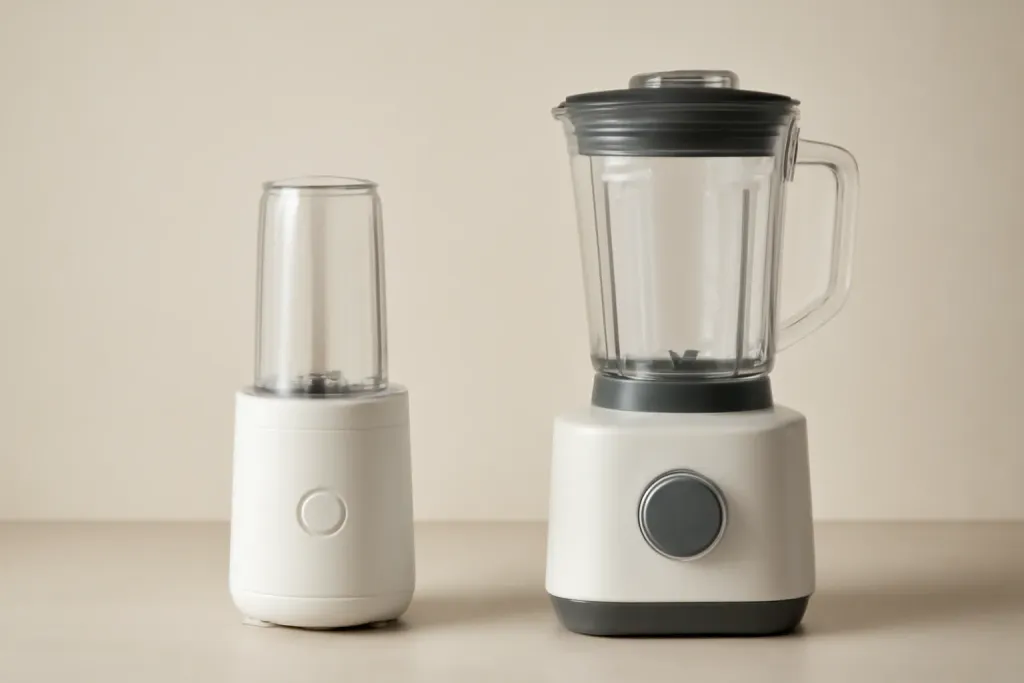
Personal Blender vs Full-Size Blender: The Core Difference
The phrase personal blender vs full-size blender usually comes down to one simple question: are you blending for one person at a time, or for a household and a wider range of tasks? Personal blenders are built around convenience and single-serve portions, while full-size blenders are designed for larger batches, more control, and broader kitchen use.
A personal blender often uses a cup or small jar that doubles as a to-go container. That design can make it appealing for quick smoothies, simple shakes, dressings, and small sauces. A full-size blender typically has a larger pitcher and a base with more controls, which can be useful when you want to prepare multiple servings or handle a mix of tasks such as purees, frozen drinks, and batters.
The better choice is not just about size. It also depends on how often you blend, what ingredients you use, how much counter space you have, and whether you prefer a fast single-step routine or a more flexible appliance. For many shoppers, the right answer is not one model that does everything, but the blender type that best fits everyday habits.
Capacity and Batch Size: How Much Do You Blend at Once?
Capacity is the most obvious difference between these two categories. Personal blenders are generally meant for one serving or a small portion. That makes them a good match if you make a morning smoothie for yourself, blend a quick protein shake, or prepare a small amount of sauce or dressing.
Full-size blenders offer more room for ingredients, which matters if you cook for more than one person or like to batch prep. A larger pitcher can be more practical for families, weekend meal prep, or recipes that need extra volume. If you often split a recipe into multiple rounds with a personal blender, a full-size model may save time and reduce repetition.
Think carefully about the size of your usual recipes. If you only ever fill a blender halfway, a large pitcher may feel awkward and wasteful. On the other hand, if you regularly need more than one serving, a personal blender can feel cramped and less efficient. Matching the container size to your actual routine is one of the easiest ways to avoid buyer’s remorse.
- Choose a personal blender if you mainly make one serving at a time.
- Choose a full-size blender if you often blend for multiple people or prep larger quantities.
- Consider a larger model if you want room to add ingredients without overfilling.
Counter Space, Storage, and Everyday Convenience
Kitchen footprint is another major consideration in the personal blender vs full-size blender decision. Personal blenders are usually compact, with smaller bases and cup-style containers that are easier to store in a cabinet or leave on a small counter. If your kitchen is tight on space, that compactness can make the appliance more appealing for daily use.
Full-size blenders take up more room, especially if you want the pitcher stored on the base or within easy reach. They may also be heavier and less convenient to move in and out of a cabinet. That can matter if you blend only occasionally and do not want a bulky appliance occupying permanent counter space.
Convenience is not only about footprint, though. A personal blender can be simpler for a grab-and-go routine because you often blend directly in the cup you will carry with you. A full-size blender may require an extra step to pour from pitcher to glass or travel container, but it also makes it easier to serve several people from one batch.
If you are deciding between the two, picture a normal weekday morning. If a small cup on a compact base fits your routine, personal may be the better match. If you regularly prep for more than one person, the added size of a full-size blender may be worth the tradeoff.
What Each Blender Type Handles Best
The best blender type depends on the ingredients you use most often. Personal blenders are usually strongest as convenience tools for softer blends and smaller recipes. They are often chosen for smoothies, shakes, small amounts of dressing, and other quick mixes that do not require a large pitcher.
Full-size blenders are more versatile for general kitchen use. Their larger jars can be better suited to soups, sauces, nut-based blends, frozen drinks, and recipes where you want more room to move ingredients around. If you cook from scratch often, the wider range of tasks may make a full-size blender more practical.
That said, no blender type is automatically better for every ingredient. Some personal blenders can handle a surprising variety of everyday jobs, and some full-size blenders are tuned for simplicity rather than heavy use. The important point is to align the machine with the ingredients you actually buy and the recipes you repeat.
- Personal blender: best for single-serve drinks and small, quick blends.
- Full-size blender: better for bigger batches and more varied kitchen tasks.
- Hybrid thinking: if you switch between small and large recipes, look for a model that matches your most frequent use first.
Controls, Speed Options, and Ease of Use
Setup and controls can influence how useful a blender feels day to day. Personal blenders often have a straightforward design: add ingredients, lock on the cup, and blend. That simplicity can be appealing if you want a fast routine and do not want to think through multiple settings.
Full-size blenders more often include several speed options, pulse functions, or preset programs. Those controls can be helpful if you want more adjustment for different textures or recipes. They may also suit users who like a little more control over the blending process rather than a single simple mode.
More controls do not always mean a better experience. For some shoppers, a personal blender’s minimal design is easier to use and clean. For others, the additional control on a full-size blender is worth the extra complexity. Consider whether you want a quick everyday appliance or a machine that gives you more options to fine-tune results.
It can also help to look at lid design, jar shape, and how easy it is to assemble parts before blending. The smoother your daily setup feels, the more likely you are to use the appliance regularly.
Browse our recommended products
Our featured picks refresh periodically. While we update them, our editorial guides can help you find the right pick.
See our guidesCleanup and Maintenance: What Fits Your Routine?
Cleanup is one of the most practical differences between the two categories. Personal blenders often score well here because the blending cup may also serve as the drinking or storage container. Fewer pieces can mean less washing and a quicker reset between uses.
Full-size blenders usually involve a larger pitcher, lid, and sometimes additional accessories. That can mean more cleanup, though many people accept that tradeoff for the larger capacity and broader usefulness. If you blend often but dislike washing extra pieces, the simpler personal blender format may be attractive.
Still, cleanup should be considered in context. A full-size blender that handles an entire recipe in one batch may actually reduce total effort if you would otherwise run a personal blender several times. Likewise, a personal blender can be easy to rinse after a small drink but less convenient if you need to make repeated batches.
For either type, the best cleaning routine is the one you can follow consistently. Look for containers and lids with shapes that are easy to rinse, and check whether the parts you care about are dishwasher-safe if that matters to you. Always follow the manufacturer’s care instructions.
Noise, Household Fit, and Daily Blending Habits
Noise is often discussed in blender shopping, but it is hard to generalize because sound levels vary by design, ingredients, and container size. A smaller personal blender may feel more manageable for quick use, but that does not guarantee a quieter experience. A full-size blender may sound more noticeable simply because it is built for larger tasks.
Instead of trying to judge noise in the abstract, think about when and where you blend. If you live with light sleepers, work from home, or use a blender early in the morning, the timing of your blending matters as much as the appliance itself. If you tend to blend once or twice a day for a very short period, the convenience of a personal blender may offset any noise concerns.
Household fit also includes who will use the blender. A personal blender is often the easier choice for one adult with a simple routine. A full-size blender may be better for shared kitchens, families, or anyone who wants one appliance to cover both small and larger tasks. The right blender is the one that fits the rhythm of your kitchen without creating unnecessary friction.
How to Choose Between a Personal Blender and a Full-Size Blender
If you are still weighing personal blender vs full-size blender, start with your most common use case rather than the most ambitious one. A blender that is perfect for an occasional recipe may not be the best everyday tool. The better question is: what will I blend most often in a normal week?
Use the checklist below to narrow the choice:
- Pick a personal blender if you usually make one serving, want a compact footprint, and value quick cleanup.
- Pick a full-size blender if you prepare larger batches, want more versatility, or often cook for more than one person.
- Favor a personal blender if you prefer simple controls and a grab-and-go cup format.
- Favor a full-size blender if you want more control options and a larger pitcher for varied recipes.
- Think about storage first if your kitchen is small, because unused appliances are easy to ignore.
In practical terms, the best blender is the one you will reach for regularly. A personal model can be a smart everyday tool for solo routines, while a full-size blender can be the better value in usefulness when you need broader capacity and flexibility. If your needs sit squarely between the two, choose the format that fits your most frequent recipe without forcing workarounds.
Bottom Line: Which Blender Type Makes More Sense?
There is no universal winner in the personal blender vs full-size blender comparison. Personal blenders are usually the better fit for simple, single-serve convenience. Full-size blenders are generally the better choice for bigger batches, wider recipe flexibility, and shared use.
The most reliable way to decide is to match the appliance to your actual habits. If you blend fast, small portions and want minimal cleanup, a personal blender may be enough. If you want one appliance to handle more people and more kinds of recipes, a full-size blender may be the more practical investment.
For many buyers, the decision is less about features on a spec sheet and more about daily behavior. Choose the blender type that makes your routine easier, not the one that sounds most capable on paper. That approach usually leads to a purchase you will use more often and with less frustration.