What each tool is actually built for
An immersion blender, sometimes called a stick or hand blender, is a handheld motor unit with a blending shaft on one end that you lower directly into a pot, pitcher, or bowl. Instead of moving food into the appliance, you bring the appliance to the food. This design was built around a specific job: pureeing soups, sauces, and batters right where they already are, without transferring hot or heavy liquid into a separate container.
A countertop blender works the other way around. Ingredients go into a fixed jar that sits on a motor base, and a blade assembly at the bottom of the jar spins to process everything inside. Countertop models typically offer a larger jar capacity than a single immersion blender pass, along with multiple speed settings and preset programs on many models. That extra capacity and control comes from a more powerful base unit and a jar designed to create consistent vortex action, which is useful for tasks like frozen drinks, nut butters, or large-batch smoothies.
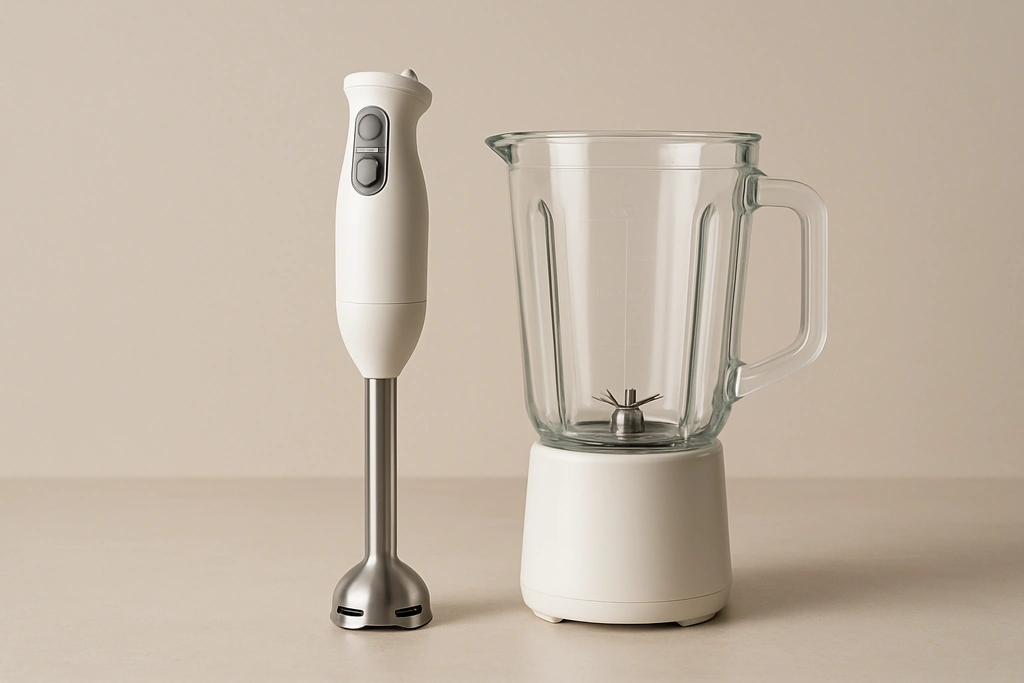
The core difference comes down to where the blending happens and how much you're processing at once. Immersion blenders excel at small to medium volumes processed in their original vessel, which matters most for hot soups, pan sauces, and single-batch dressings. Countertop blenders are built for repeatable, larger-volume blending where you want a smooth, uniform result and don't mind dedicating counter or cabinet space to a standalone appliance.
Attachments also separate the two categories. Many immersion blender kits include interchangeable heads such as a whisk attachment or a small chopping bowl, turning one motor body into a few different tools. Countertop blenders sometimes offer swappable jar sizes or personal cups, but the core function stays centered on the main jar. Neither format is inherently better; they're built around different physical workflows, and the right pick depends on what you actually cook and how often.
Motor wattage is worth understanding as a general concept rather than a number to chase. Higher wattage generally supports processing tougher ingredients or larger volumes without straining, but wattage figures aren't directly comparable across brands or blade designs, so it's more useful as a rough indicator than a precise measurement. What matters more in daily use is whether the blade geometry and jar or shaft shape match the textures you blend most.
Decision criteria: matching the tool to the task
Start with what you blend most often. If your kitchen routine leans toward pureed soups, gravies, pan sauces, or single-serving smoothies made directly in a mug or measuring cup, an immersion blender lines up naturally with that workflow. You can puree a pot of soup on the stovetop, blend a small batch of dressing in a jar, or froth a sauce without dirtying a large jar and lid.
If your routine centers on larger-batch blending such as family-sized smoothies, frozen drinks, or grinding dry ingredients into flours and meals, a countertop blender's fixed jar and stronger base tend to produce more consistent results. The sealed jar and lid design also make it easier to blend larger liquid volumes without splatter, which matters if you're processing more than a cup or two at a time.
Capacity is the next filter. Immersion blenders don't have a jar of their own; whatever vessel you use in the moment sets the practical volume limit. That's flexible but means very large batches can take multiple passes or require moving the blender between containers. Countertop jars come in a defined capacity, so once you know your typical batch size, you can compare that against a jar's stated capacity to see whether it matches without over- or under-filling.
Counter and storage footprint matter just as much as blending performance. A countertop blender occupies a fixed footprint on the counter or in a cabinet at all times, even when not in use, and its jar, lid, and blade base all need a storage spot. An immersion blender's slim shaft and compact motor body generally tuck into a drawer or narrow cabinet gap, which is a meaningful advantage in smaller kitchens or apartments with limited counter space.
Texture goals also point toward one format or the other. If you want a completely uniform, silky result across a large volume, such as a fully smooth soup for a big batch of leftovers, a countertop blender's consistent vortex action tends to deliver that evenly. If you're finishing a dish in the same pot it cooked in and want to control texture as you go, checking consistency in real time, an immersion blender's direct, hands-on control makes that easier to manage.
Finally, consider whether you need both. Many households use an immersion blender for weekday soups and sauces while keeping a countertop blender on hand for weekend smoothies or occasional large-batch projects. Buying based on your three or four most frequent tasks, rather than every hypothetical use case, keeps the decision practical instead of aspirational.
Browse our recommended products
Our featured picks refresh periodically. While we update them, our editorial guides can help you find the right pick.
See our guidesLimitations of each format
Immersion blenders have real limits worth knowing before you rely on one as your only blending tool. Very thick mixtures, large ice loads, or tough frozen fruit can be harder for a handheld shaft to process evenly compared with a countertop jar built around that kind of load. Because the blade sits at the tip of a narrow shaft, it also needs enough liquid or volume around it to work properly; very shallow or very small amounts of food can be tricky to fully blend without tilting the container or using an included small-batch cup.
Splatter is another practical tradeoff. Since blending happens in an open pot or bowl rather than a sealed jar, immersion blenders can push liquid up and out if you move the shaft too high or blend at full speed near the surface. Most manuals recommend keeping the blending head fully submerged and starting at a lower speed, which is worth following as a general practice rather than something to work around.
Countertop blenders carry a different set of tradeoffs. Their fixed jar means you're committed to a fairly large capacity even for small jobs, which can mean using more ingredients than you need just to reach a workable blending depth. Transferring hot liquid, like a just-cooked soup, from a pot into a countertop jar also introduces an extra step and a real handling consideration; many manufacturers advise letting hot liquids cool somewhat and filling the jar only partway before blending hot contents, so check your specific manual for guidance before doing this.
Countertop units also take up a fixed amount of space whether or not they're being used, and the jar, lid, and blade assembly typically need to be stored together as a set. If your kitchen has limited cabinet space, that footprint is a genuine ongoing cost, not just a one-time consideration at purchase.
Neither format is well suited to every job. An immersion blender generally isn't the right tool for dry grinding or for processing very large batches in one pass, while a countertop blender isn't as convenient for quick, in-pot finishing tasks or for blending directly in a serving vessel. Matching expectations to these limitations up front avoids frustration later, and it's part of why many cooks eventually keep both types on hand for different jobs rather than expecting one tool to cover everything.
Cleaning and storage
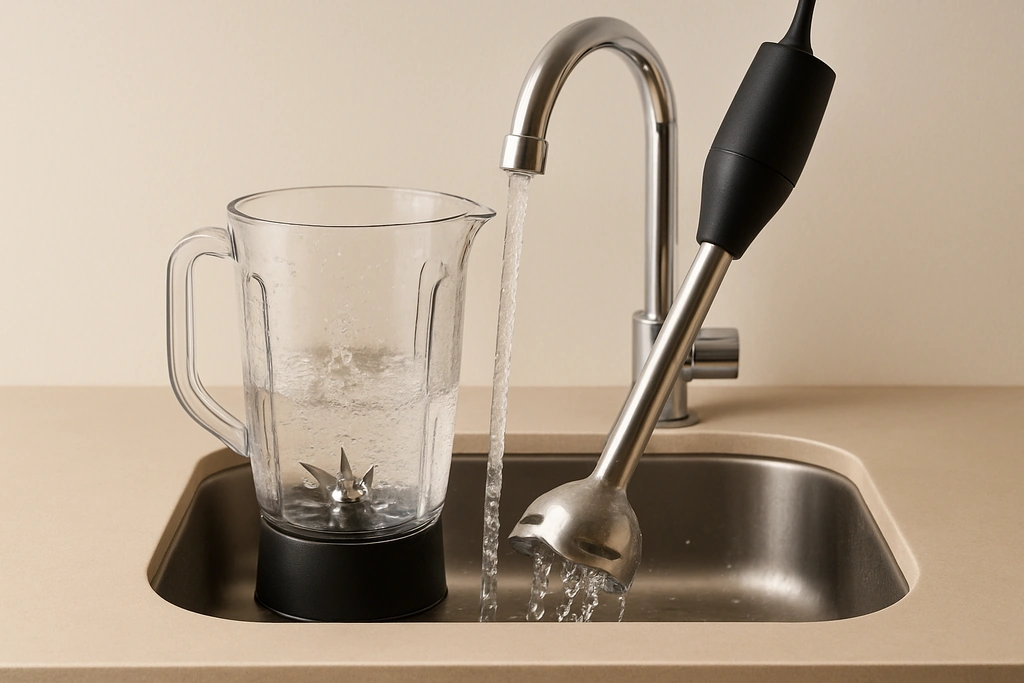
Cleaning routines differ noticeably between the two formats, and that difference often ends up shaping which tool gets reached for on a busy weeknight. An immersion blender's shaft can typically be rinsed under running water right after use, since the blade and shaft are the only parts that contact food. Many models have a detachable blending shaft that separates from the motor body, and that shaft is often dishwasher-safe, though you should always confirm this in the manufacturer's manual before placing any part in a dishwasher, since motor housings themselves are never meant to be submerged or washed.
Countertop blenders involve more components: the jar, the lid, any small measuring cap, and the blade assembly at the jar's base. Many jars and lids are dishwasher-safe, but the blade assembly sometimes requires hand washing or a quick blend with warm water and a drop of dish soap to clear residue from the underside of the blades, where fingers can't safely reach. Checking the manual for which parts are dishwasher-safe and which need hand care helps avoid clouding a jar or dulling a blade over time.
Storage is where the two formats diverge most. An immersion blender's slim profile means it can usually hang in a utensil crock, lie flat in a drawer, or stand in a narrow gap between cabinets, especially if it comes with a wall-mount clip or storage case. A countertop blender needs a dedicated spot for the full assembly, jar included, which is worth measuring against your available counter or cabinet clearance before buying, particularly if your kitchen already has limited storage.
Longevity in either case comes down to routine care rather than any single feature. Rinsing immediately after use, before food residue dries onto blades, keeps both formats performing consistently and makes deep cleaning far less frequent. Always unplug an immersion blender or make sure a countertop blender's base is switched off before handling blades, and never attempt to open a motor housing or repair internal electrical components yourself; any motor issue, unusual noise, or performance problem should be directed to the manufacturer's manual or customer support rather than investigated or disassembled at home.
Ultimately, the tool that gets cleaned easily is the tool that gets used regularly. If a quick rinse under the tap fits your routine better than washing a multi-part jar, that alone might tip the decision toward an immersion blender, and the reverse is just as valid for households that prefer one thorough cleanup after a larger blending session.