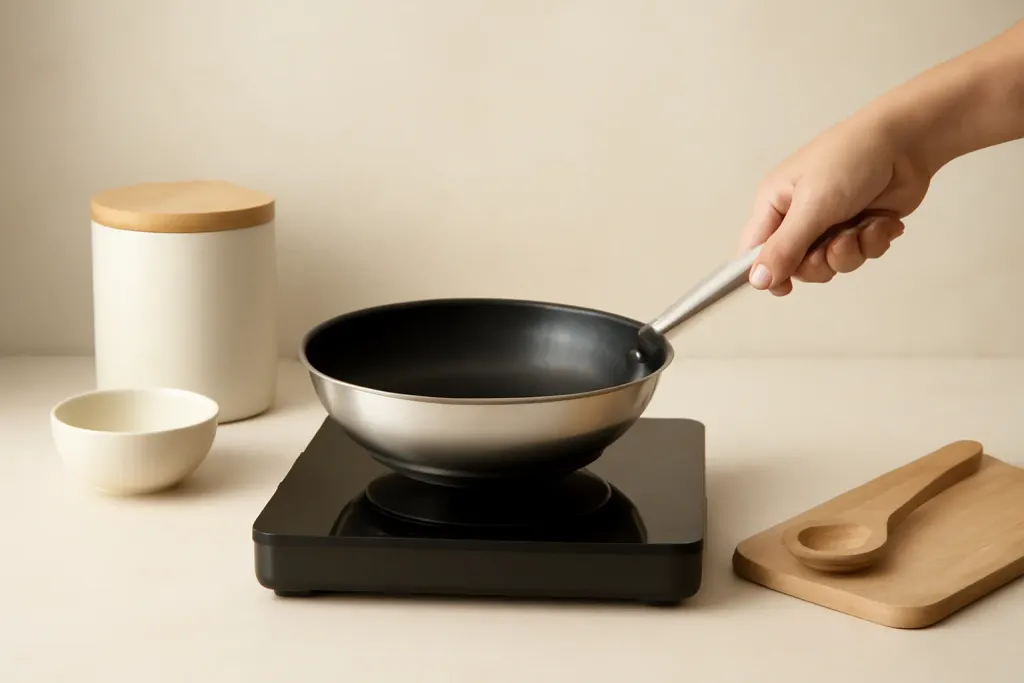
How Induction Cooktops Detect Cookware
To understand how to check whether cookware works on induction, it helps to know what the cooktop is looking for. Induction burners create a magnetic field that interacts with cookware that contains magnetic material. The pan itself becomes part of the heating process, so the cooktop needs to sense a suitable base before it can deliver power as intended.
That is why cookware compatibility is not only about the pan’s appearance or price tier. Two pans that look similar can behave differently if one has a magnetic base and the other does not. Even within the same material family, construction can vary enough to change how a cooktop responds.
For consumers, the useful takeaway is simple: a pan must be both magnetic enough and sized appropriately for the burner. If either part is off, the cooktop may not recognize the cookware or may only heat it inconsistently.
Check Labels and Product Copy First
The first step in how to check whether cookware works on induction is to look for the manufacturer’s own statement. Many products include an induction symbol on the base, on the packaging, or in online listing details. Other wording may say induction compatible, suitable for induction, or suitable for all cooktops.
That said, wording can be inconsistent, and broad material labels are not enough by themselves. Stainless steel, for example, is a useful clue but not a guarantee. Some stainless cookware is magnetic and induction-ready, while other stainless items are not responsive enough for induction cooking.
If the listing is vague, treat it as incomplete rather than assuming compatibility. Product copy written by the maker is usually more useful than a general material description, especially when the cookware uses a layered or bonded base.
Use a Magnet as a Screening Test
A small magnet is the most practical home check. Hold it against the underside of the pan, and if needed, test a few spots near the center and outer edge of the base. A firm stick usually indicates that the cookware is likely to work on an induction cooktop.
If the magnet does not stick, the pan is usually not induction-compatible. If the pull is weak or only appears in one area, the cookware may work on some burners but not on others, or it may respond unevenly. In that situation, the magnet test should be treated as a clue, not a final answer.
This is a screening method, not a laboratory test. It does not measure how well a pan cooks, only whether the base is likely to interact with the cooktop. That is still useful, because it helps separate clearly compatible cookware from cookware that needs more confirmation.
Look at Base Shape and Flatness
Induction cooktops generally do better with cookware that has a flat bottom and solid contact on the glass surface. A warped or domed base can reduce contact and lead to poor detection, even if the cookware contains magnetic material. Flatness matters because the cooktop must sense the pan reliably before it can operate.
When inspecting a pan, look for a base that sits evenly without rocking. Also look for a visibly thicker bottom section, which may indicate an encapsulated or layered construction. Many induction-ready pans use a bonded disc or multi-layer base rather than a fully magnetic body.
A thicker-looking base is not proof of compatibility on its own, but it is often a useful clue. If the pan looks uneven, bent, or badly worn, that may affect its behavior on induction regardless of what the label says.
Know the Material Clues That Usually Matter
Material can help you narrow things down, but it should not be the only factor you use. Cast iron is commonly induction-compatible because it is naturally magnetic. Many enameled cast iron pieces also work, provided the base remains magnetic and reasonably flat.
Magnetic stainless steel often works as well, though not every stainless steel pan will activate an induction burner. If a product listing simply says stainless steel, that is not enough information to rely on without either a magnet test or an explicit induction statement.
Aluminum, copper, and glass are generally not induction-ready unless they include a magnetic layer or bonded base. That is why some cookware made with these materials still works on induction while other pieces do not. The construction details matter more than the outer finish.
Browse our recommended products
Our featured picks refresh periodically. While we update them, our editorial guides can help you find the right pick.
See our guidesCheck the Cooktop’s Response to the Pan
Once you place the pan on the burner, the cooktop’s behavior can provide another clue. If the burner recognizes the pan promptly, that supports compatibility. If the display flashes an error, the burner turns off, or the unit does not respond at all, the cookware may not meet that cooktop’s sensing requirements.
Recognition is not the same as ideal performance. A cooktop may detect a pan that is only partly magnetic, too small, or not flat enough, but still deliver inconsistent heating. So if the burner activates only intermittently, do not assume the cookware is a perfect match.
Some induction cooktops also have minimum pan-size requirements. A small saucepan may fail to register on a larger burner even if the material is magnetic. In other words, a negative response from one burner does not automatically prove that the pan will fail everywhere.
Match Pan Size to Burner Size
Pan size matters more on induction than many shoppers expect. The base needs to cover enough of the sensing area for the cooktop to detect it reliably. If the cookware is much smaller than the burner zone, the burner may not activate or may cycle on and off.
Very large pans can also be a poor match if the magnetic base does not align well with the coil area. In that case, the center may respond while the edges behave less predictably. This is one reason the same pan can feel fine on one burner and less cooperative on another.
When you are comparing cookware, base diameter is more useful than the top rim size. A wide-rimmed pan with a modest bottom may not behave like a pan with a broad, flat base. For a home check, the best comparison is the part that actually sits on the cooktop.
What to Do When You’re Still Unsure
If the label is unclear and the magnet test is only partly convincing, the conservative approach is to leave the cookware in the uncertain category until you can verify more details. The manufacturer’s product page, packaging, or care sheet may clarify whether the base is induction-ready. If those details are missing, it is better to be cautious than to assume the pan will work.
A practical way to organize your decision is to sort cookware into three groups: clearly compatible, clearly incompatible, and uncertain. Clearly compatible cookware has a firm magnetic response and a clear induction statement. Clearly incompatible cookware has no magnetic attraction and no induction claim. Uncertain cookware has mixed or incomplete evidence and should not be relied on without more confirmation.
For shoppers building a cookware set, this approach reduces guesswork. It also helps avoid buying a pan that looks suitable on paper but does not register on the burner once it is at home.
Quick Home Checklist Before You Cook
If you want a simple recap of how to check whether cookware works on induction, use this order: first, look for an induction symbol or explicit compatibility statement; second, confirm with a magnet; third, inspect the base for flatness and solid construction; fourth, make sure the pan size fits the burner you plan to use.
None of these steps by itself is perfect, but together they give a dependable picture of likely compatibility. That matters because cookware can be magnetic yet still behave poorly if the base is warped, too small, or oddly constructed.
If a pan passes the label check, the magnet check, and the size check, it is much more likely to be a good induction match. If it fails two of those checks, it is usually better to choose another pan rather than try to make it work.