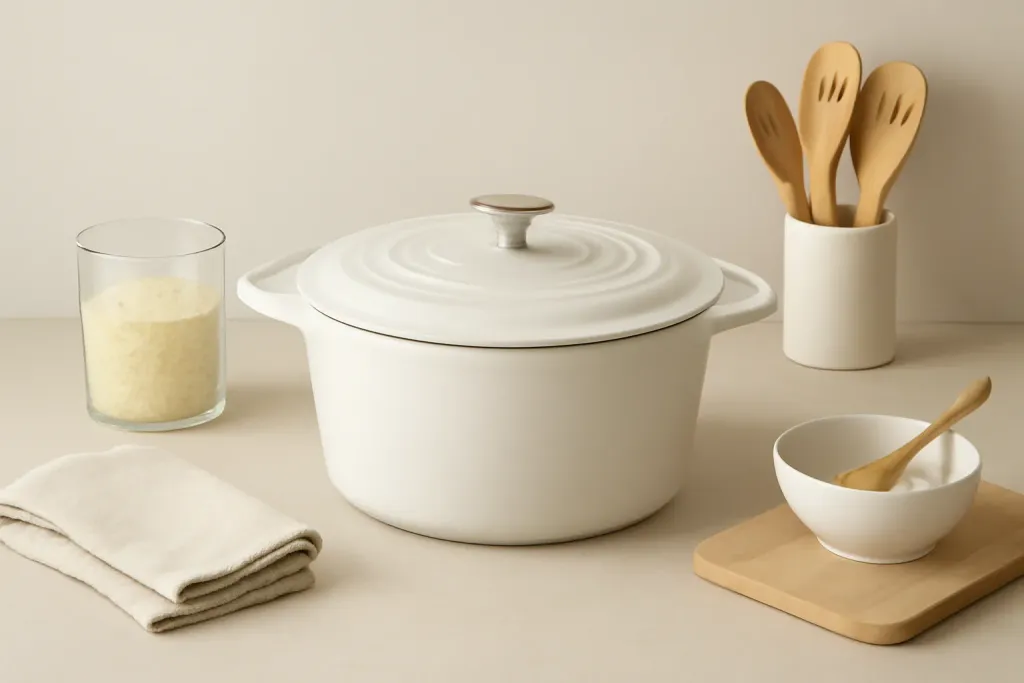
How Dutch Oven Sizes Are Measured
A dutch oven size guide usually starts with capacity, most often shown in quarts or liters. Some brands also list diameter and depth, but capacity is the most useful starting point because it tells you how much food the pot can hold. A 5-quart model, for example, is not simply about the width of the pot; it reflects the overall volume available for ingredients, liquid, and steam circulation.
When comparing products, look for more than one measurement. The same quart rating can feel different depending on the pot shape, wall height, and lid design. A round, deeper pot may suit braises and soups, while a wider, shallower version can be easier for browning meat or baking bread. Handle style matters too, because a large pot with heavy side handles may be harder to move even if the capacity seems manageable.
It also helps to separate
- nominal capacity, which is the listed size
- usable capacity, which is the practical fill level for cooking
- external dimensions, which affect storage and oven clearance
For most home cooks, the label is a starting point rather than the full story. Think about what you cook most often, how many people you serve, and whether the pot must fit inside a small oven, on a compact stovetop burner, or in storage with limited cabinet space.
Small Dutch Ovens for One to Two People
Small dutch ovens, generally around 1.5 to 3 quarts, work well for side dishes, small batches of soup, reheating, and baked recipes for one or two people. They are also a reasonable choice if you want a lighter pot that is easier to lift when full. For households with limited storage, a smaller pot can be a practical everyday piece rather than an occasional specialty item.
These sizes can be useful when you do not want excess empty space in the pot. Too much unused volume can affect how ingredients cook, especially in small recipes where you want enough contact between the food and the cooking surface. A compact pot can help keep stews, grains, and sauces more concentrated without requiring a large amount of liquid.
That said, very small dutch ovens are not ideal for every task. If you often cook for guests, make one-pot pasta, or prepare large cuts of meat, a 2-quart pot may feel limiting. It is best to think of these as focused tools for small-volume cooking rather than all-purpose vessels.
For a dutch oven size guide aimed at solo cooks or couples, a 2.5- to 3-quart pot is often a balanced middle ground. It offers enough room for everyday cooking while staying compact enough for easier handling and storage.
Medium Sizes for Everyday Use
Medium dutch ovens, especially 4 to 6 quarts, are the most versatile option for many kitchens. This range is large enough for family meals, braises, baked pasta, and larger soups, but not so large that it becomes awkward for routine use. If you are buying just one pot, this category is often the first place to start.
A 5-quart dutch oven is frequently a practical middle point. It can handle a modest roast, a batch of chili, or enough dough for rustic bread without taking up the footprint of a very large vessel. Many cooks find this size easier to justify because it supports both weekday meals and weekend cooking projects.
Within this range, shape and depth matter. A wider 5-quart model may brown better and provide more surface area for reducing sauces, while a deeper one may be better for soups and stews. If your main goal is oven cooking, either can work. If your main goal is stovetop simmering, a deeper pot may help reduce splatter.
Medium sizes also tend to fit a broader range of cooking scenarios without excessive leftover space. That can be useful when making recipes that rely on even heat distribution and predictable liquid levels. For many households, this is the most forgiving category in a dutch oven size guide because it balances flexibility, storage, and day-to-day convenience.
Large Dutch Ovens for Families and Batch Cooking
Large dutch ovens, usually 7 quarts and up, are suited to bigger households, batch cooking, holiday meals, and recipes that need extra headroom. They are also helpful when you want to cook a whole chicken, a large roast, or a generous quantity of soup in one vessel. The added capacity can make stirring easier, and it can provide more room for ingredients that expand during cooking.
These sizes are not automatically better, though. A large pot can be cumbersome to move when full, and it may feel excessive if you usually cook for one or two people. It can also take longer to heat up, simply because there is more material and volume involved. For some kitchens, that tradeoff is acceptable; for others, it is not.
If you frequently cook for a crowd, a larger pot may be the right long-term choice. If you only occasionally need the extra space, consider whether a medium dutch oven plus a second smaller pot would be more useful than one oversized vessel. The best choice depends on how often you need volume versus how often you need convenience.
When evaluating a large option, check the weight, lid fit, and whether the pot can safely fit in your oven with enough clearance. A large dutch oven that is difficult to maneuver may be less practical than a smaller one that gets used regularly.
Browse our recommended products
Our featured picks refresh periodically. While we update them, our editorial guides can help you find the right pick.
See our guidesMatching Size to Common Recipes
The easiest way to use a dutch oven size guide is to match capacity to the types of recipes you make most. Different foods benefit from different amounts of empty space, surface area, and depth. A pot that works for a stew may be too small for bread, while a pot that suits a roast may feel oversized for a sauce.
General pairings often look like this:
- 1.5 to 3 quarts: side dishes, grains, small soups, reheating, and cooking for one or two
- 4 to 5 quarts: everyday soups, casseroles, braises, and moderate batches of chili or pasta
- 6 to 7 quarts: family stews, large roasts, bread baking, and batch cooking
- 8 quarts and above: large gatherings, extended batch cooking, and recipes that need extra room
For bread baking, many cooks prefer enough space for dough expansion and lid clearance. For soups and stews, depth and stability matter more than a wide footprint. For roasts, a pot should allow you to fit the meat and vegetables without crowding, while still leaving some room for browning and steam control.
It is also worth considering whether you cook mostly on the stovetop or in the oven. A pot that is perfect for simmering may not be the most comfortable size for moving in and out of a hot oven. Choosing based on your most common recipes is usually more reliable than buying based on an occasional specialty dish.
Weight, Handling, and Storage Considerations
Capacity is important, but a dutch oven size guide should also account for handling. As size increases, so does the amount of food the pot can hold, and that can make the finished dish much heavier. Even before you add ingredients, the pot itself may be substantial. A larger lid, thicker walls, and bigger handles all affect how easy it is to lift and turn.
Think about the path from counter to stovetop to oven. If you cook in a kitchen with limited landing space, a very large pot may be harder to handle safely. The same applies to storage. Measure cabinet height, shelf depth, and oven clearance before choosing an oversized model. A pot that barely fits may be inconvenient even if it looks ideal on paper.
Handle design can make a meaningful difference. Loop handles, ear handles, and knob styles vary in how comfortable they are to grip with oven mitts. The easiest pot to use is often not the largest or most feature-heavy one, but the one you can move confidently when full.
For many shoppers, a practical approach is to choose the smallest size that still covers the majority of recipes. That often results in better everyday use, less strain when lifting, and fewer storage headaches. If you need a second pot later, you can add a specialized size instead of forcing one pot to do everything.
Choosing Your First Dutch Oven
If you are buying your first dutch oven, start with your household size and cooking habits. A couple or solo cook may be well served by a 3- to 5-quart pot, while a family that often makes soup, braises, or baked dinners may prefer 5 to 7 quarts. The goal is to buy for the meals you actually make, not for the biggest recipe you might try once.
A sensible first purchase is usually a medium size because it offers the widest range of use. It can handle everyday meals without feeling too small, and it avoids the awkwardness that sometimes comes with an oversized pot. If you are unsure between two sizes, the one with more versatility across your most common recipes is often the safer choice.
Material and construction still matter, but size should come first. A well-chosen capacity can make an average recipe easier to manage, while a poorly chosen one can make even a good pot frustrating to use. If you expect to cook mostly on weekends or only a few times a month, a multi-purpose medium pot may be the most practical starting point.
In short, the best dutch oven size is the one that fits your portions, storage, and routine. A thoughtful size choice can help ensure the pot earns a regular place in your kitchen rather than sitting unused.
Quick Size Checklist Before You Buy
Before selecting a dutch oven, it helps to run through a short checklist. This keeps the decision focused on practical use rather than on a single number on the box.
- How many people do you usually cook for?
- Do you make soups, braises, bread, or roasts most often?
- Will the pot fit in your oven and storage area?
- Can you lift it comfortably when full?
- Do you want one all-purpose pot or a specialized size?
If your answers point in different directions, prioritize the task you do most often. For many shoppers, a 5-quart pot is the most balanced answer. For smaller kitchens, 3 quarts may be easier to live with. For larger households or batch cooking, 7 quarts may be more appropriate.
A dutch oven size guide is most useful when it reflects how you cook in real life. By focusing on capacity, handling, and common recipes, you can choose a pot that feels useful from the start and remains convenient over time.