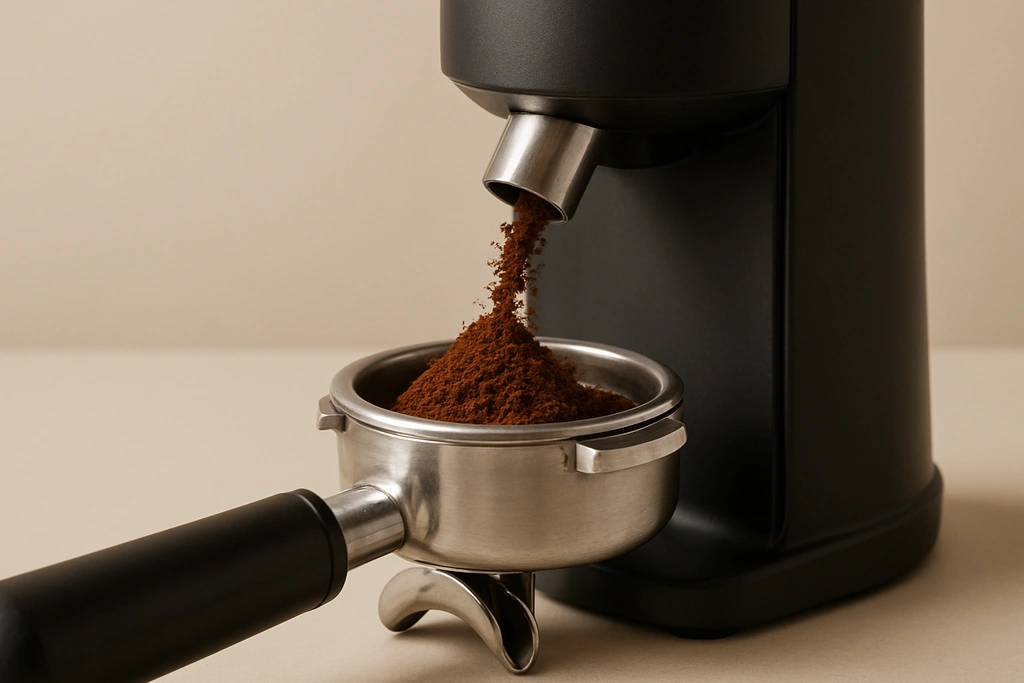
Why grind quality matters for espresso
Espresso is one of the most demanding brewing methods when it comes to grind quality. Water is forced through a compact puck of coffee at high pressure in a short amount of time, and how evenly the coffee is ground has an outsized effect on how that extraction goes. A grinder that produces a wide range of particle sizes in the same batch — some very fine, some coarse — tends to create uneven flow paths through the puck. Water finds the path of least resistance, moving quickly through looser spots and slower through denser ones, which can lead to a shot that tastes both under-extracted and over-extracted at the same time.
This is different from grinding for drip coffee or a French press, where a broader range of particle sizes is far more forgiving. Because espresso uses so much pressure over so little time, small inconsistencies in grind size are magnified. That is the main reason dedicated espresso grinders exist as a category: they are built around producing a narrow, consistent particle size at the fine end of the spectrum, rather than trying to cover every brew method at once.
Grind quality for espresso is generally judged on a few things: how fine the grinder can go without stalling or producing excessive heat, how consistent the particles are at that fine setting, and how repeatable the setting is from one session to the next. A grinder that can technically reach a fine setting but does so unevenly will still leave you chasing an inconsistent shot, even if every other part of your setup — the machine, the beans, the tamp — is solid.
It's also worth understanding that grind size and grind consistency are two separate qualities. A grinder can produce a very fine average particle size while still having a wide distribution around that average. When shopping, it helps to think about both: can this grinder get fine enough for espresso, and does it do so with minimal spread between the smallest and largest particles in a batch? Reviews and product descriptions that focus only on the numeric range of settings, without addressing consistency, are only telling half the story.
Finally, consider how grind quality interacts with the rest of your routine. If you plan to brew other methods on the same machine — pour-over, drip, or French press — you will want a grinder with a wide enough adjustment range to cover those coarser settings too, not just the fine end needed for espresso.
Decision criteria: burr type, range, and consistency
The mechanism inside a grinder is usually described as either conical burr or flat burr. Conical burrs use a cone-shaped inner burr rotating inside a matching outer ring, while flat burrs use two parallel ridged discs. Both designs can be built to handle espresso-fine grinding, and both are common in home and semi-commercial machines. Rather than treating one as universally superior, it helps to compare specific models within each category, since build quality and calibration matter as much as the general mechanism type.
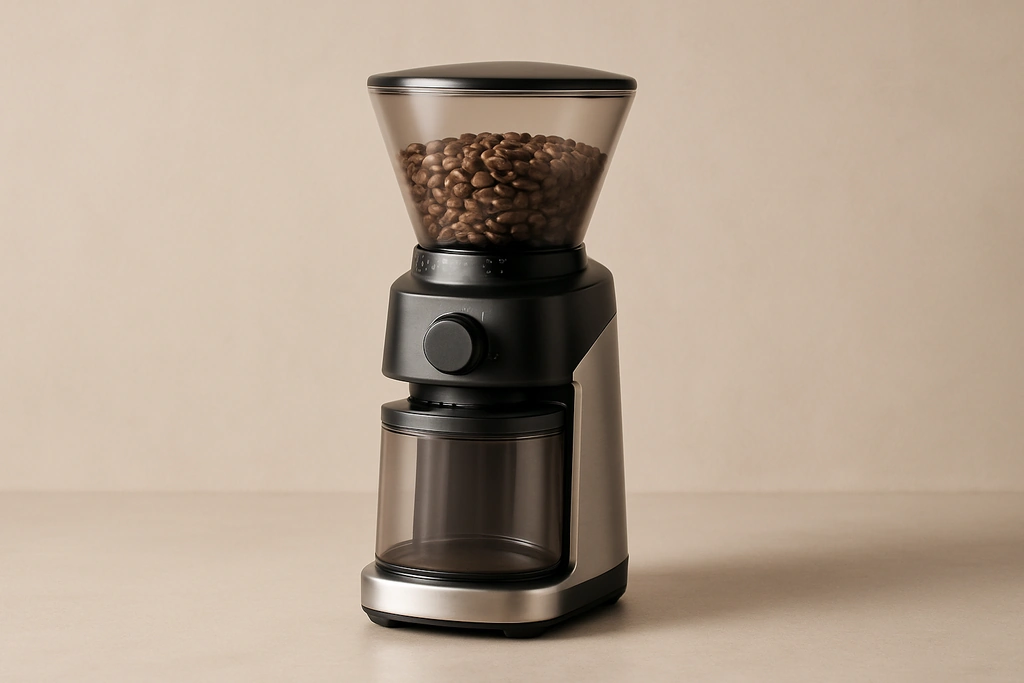
Grind range is the next major factor. Look for a grinder whose adjustment dial or dial-and-lever system explicitly covers the fine end of the spectrum needed for espresso, not just drip or pour-over ranges. Some grinders marketed as "all-purpose" have a wide overall range but relatively coarse increments at the fine end, which makes it hard to dial in the small adjustments espresso often requires. A grinder with fine-grained "micro-adjustment" at the espresso end of its range gives you more control when a shot is running too fast or too slow.
Dosing method is another practical consideration. Some grinders dispense directly into a portafilter, some use a removable catch cup, and single-dose grinders are designed to be loaded with just enough beans for one shot at a time, with little to no retained grounds between uses. Each approach has tradeoffs in convenience versus mess and workflow. If you grind multiple shots back-to-back in the morning, a hopper-fed grinder with a catch cup may fit your routine better than a single-dose model that asks you to weigh and load beans every time.
Hopper capacity and static behavior at fine settings round out the practical decision criteria. A larger hopper means less frequent refilling if you drink espresso daily, but it also means beans sit longer before grinding, which some coffee drinkers prefer to avoid for freshness reasons. At fine settings, ground coffee can develop static charge and cling to the chute or bin — a behavior sometimes called "clumping" or static cling. This doesn't indicate a defect, but it's worth knowing that some grinders include design features, like anti-static mechanisms or grounds bins, intended to reduce this effect. Weigh how much mess and cleanup you're willing to tolerate against the price and footprint of grinders that address it more directly.
Browse our recommended products
Our featured picks refresh periodically. While we update them, our editorial guides can help you find the right pick.
See our guidesLimitations to weigh
No grinder is the right fit for every kitchen, and it helps to think through the genuine tradeoffs before buying rather than after. The most consistent, fine-capable espresso grinders tend to be larger and pricier than basic all-purpose models. If counter space or budget is limited, you may be choosing between a compact grinder that handles espresso adequately but not exceptionally, or a larger, more capable unit that takes up significantly more room. There isn't a way around this tradeoff — it's a direct consequence of the burr size and motor needed for fine, consistent grinding.
Single-dose grinders, which avoid retaining old grounds between uses, ask more of the user in return. Because there's no hopper reservoir, you typically weigh out beans before each grind and may need to purge a small amount of retained grounds from the chute, adding a short but real step to your routine every time you make a shot. For someone brewing one coffee a day, this extra step may be a small price for freshness and less cleaning. For a household making several espresso drinks each morning, that repeated weighing and loading can start to feel like friction.
Grinders with a wide overall adjustment range, covering everything from espresso to French press, sometimes sacrifice the fine-tuning precision that a dedicated espresso grinder offers at the narrow end of its range. If your main use case is espresso specifically, a grinder optimized for that range may serve you better than a generalist model, even if the generalist covers more brew methods on paper.
It's also worth acknowledging what a grinder cannot fix. Grind quality is only one variable in a shot of espresso — the freshness and roast of the beans, the espresso machine's pressure and temperature stability, and the barista's technique with tamping and dosing all play a role. Upgrading a grinder will not compensate for stale beans or an inconsistent machine, and it's reasonable to expect gradual improvement rather than an overnight transformation in your shots.
Finally, keep manufacturer guidance in mind for any issue beyond routine use. If a grinder's burrs seem misaligned, if grind settings stop producing consistent results, or if you suspect a mechanical problem, refer to the manufacturer's manual or contact their support rather than attempting to disassemble the motor or burr assembly yourself.
Cleaning and everyday care
Routine cleaning is one of the simplest ways to keep a coffee grinder for espresso performing consistently over time. Ground coffee leaves behind fine particles and oils, particularly from darker roasts, that can build up in the hopper, chute, and burr chamber if left unaddressed. A light daily habit of brushing out visible grounds from the chute and catch area, combined with a more thorough weekly wipe-down of the hopper, goes a long way toward preventing stale buildup from affecting flavor.
Most grinders benefit from an occasional deeper clean using dry grinder-cleaning tablets or pellets designed for that purpose, run through the burrs to help dislodge oily residue that a brush alone can't reach. Always check the manufacturer's manual before using any cleaning product, since not every grinder is designed to handle the same cleaning tablets, and using an incompatible product could affect performance.
Static and clumping at fine grind settings are common and not a sign of malfunction, but they do call for a bit of extra attention during cleanup. Grounds can cling to the inside of the chute or grounds bin, and a small brush kept next to the grinder makes it easy to clear these spots after each use rather than letting residue accumulate over days or weeks.
Beyond routine cleaning, avoid opening the grinder's motor housing or attempting to recalibrate internal burr alignment yourself. If a grinder needs burr replacement, motor service, or recalibration beyond the adjustment dial provided, that work should go through the manufacturer's instructions or authorized support channels. Attempting diagnostic or repair work beyond the manual's routine cleaning guidance risks damaging the grinder and can void any manufacturer coverage.
Lastly, store whole beans away from the grinder's hopper when the machine won't be used for an extended stretch, since prolonged exposure to air can dull flavor regardless of how well the grinder itself is maintained. Keeping the hopper mostly empty between uses, refilling only what you'll grind within a reasonable window, is a simple habit that pairs well with routine cleaning to keep your espresso grinder performing the way it did when it was new.