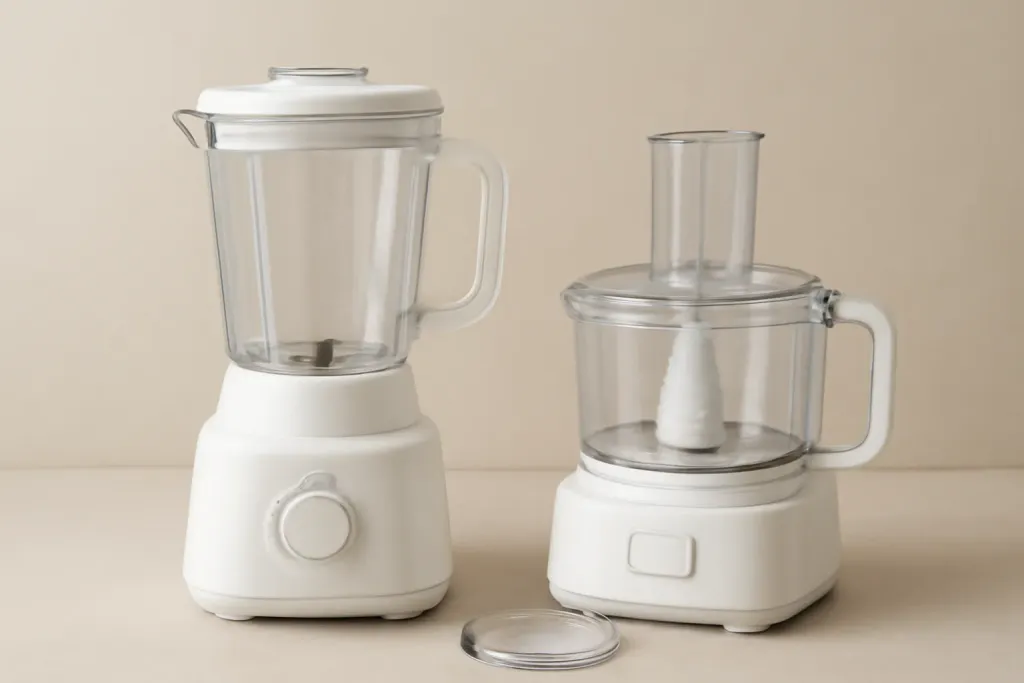
Blender vs Food Processor: The Basic Difference
When comparing blender vs food processor, the simplest way to think about it is this: a blender is built to move ingredients into a smooth liquid or semi-liquid result, while a food processor is built to chop, slice, shred, mix, and combine ingredients with more control over texture. Both are useful countertop appliances, but they are not interchangeable in every task.
A blender typically has a tall jar and a blade system designed to pull ingredients downward toward the blade path. That shape makes it a natural fit for smoothies, purées, sauces, and frozen drinks. A food processor usually has a wider work bowl and multiple attachments or discs. That wider bowl makes it easier to handle larger pieces of vegetables, doughs, nut mixtures, and coarse chopping tasks without turning everything into a liquid.
If you mostly want silky results, a blender often makes more sense. If you want texture control and more variety in prep work, a food processor usually offers more flexibility. Many kitchens benefit from having both, but if you are choosing only one, the better pick depends on how you cook most often.
What a Blender Is Best For
A blender is the better tool when you want a uniform, smooth consistency. It is commonly used for drinks and mixtures where ingredients need to be fully broken down into a liquid base. That includes smoothies, milkshakes, puréed soups, salad dressings, emulsified sauces, and blended beverages. For many home cooks, this is the appliance that gets used most for breakfast and quick meal prep.
The tall container helps ingredients circulate around the blades, and that shape is useful when liquid is part of the recipe. If you are making a smoothie, for example, the blender is designed to combine fruit, ice, yogurt, and liquid into a consistent drink. A food processor can handle some of those ingredients, but the result is usually thicker, less uniform, and less suited to drinking through a straw.
Blenders also make sense for recipes that benefit from aeration and smoothness. For instance, a puréed vegetable soup can be taken from coarse cooked ingredients to a more even texture. Dressings and sauces can also be mixed efficiently, especially when the recipe starts with liquid ingredients and only needs a short blending time.
That said, a blender is not the best choice for every kitchen job. Because it is built around the blending chamber and blade flow, it is less convenient for tasks that need visible piece sizes, like uniformly chopped onions or shredded cheese. If your cooking style leans toward prep work rather than drinks and purées, a food processor may be the more practical appliance.
What a Food Processor Is Best For
A food processor is designed for prep work that involves cutting, chopping, slicing, shredding, and mixing. If a blender is about smoothness, a food processor is about versatility and texture control. It is often the appliance of choice for tasks that would otherwise take a knife, box grater, or extra mixing bowl.
One of the biggest advantages of a food processor is the wide bowl and feed tube. Those features make it easier to process ingredients in batches and to keep some structure in the final result. That is useful when making salsa, coleslaw, vegetable fillings, nut mixtures, breadcrumbs, pesto, or pie crust. It can also be helpful for tasks that involve chopping a lot of vegetables at once, especially when you want more consistency than hand chopping usually provides.
Many food processors include slicing and shredding discs, which extend their usefulness beyond simple chopping. This is one reason they are often favored by cooks who prep larger amounts of ingredients for salads, side dishes, and meal components. They can also mix doughs or thick mixtures more comfortably than a blender, since the bowl is wider and less dependent on liquid for movement.
For any recipe where you want a coarse, even texture rather than a smooth finish, a food processor is usually the better fit. It gives you more control over how far the ingredients are broken down, which is helpful when texture is part of the final dish.
Blender vs Food Processor by Common Kitchen Task
If you are deciding between the two appliances, it helps to match the tool to the task. A few common kitchen jobs make the difference easier to see.
- Smoothies and shakes: blender
- Puréed soups: blender
- Salad dressings and thin sauces: blender or food processor, depending on texture goals
- Salsa and chunky dips: food processor
- Vegetable chopping: food processor
- Shredding cheese or vegetables: food processor with the proper disc
- Nut butters: either one in some cases, but a food processor is often more practical for thicker mixtures
- Dough mixing: food processor
- Frozen drinks with enough liquid: blender
This kind of task-based comparison is often more useful than comparing the appliances in the abstract. A blender may technically be able to process some foods that a food processor handles, but the result, texture, and ease of use can differ enough to matter in daily cooking. The best appliance is the one that matches your most common recipes.
It is also worth noting that recipes are written with certain tools in mind. If a recipe calls for a coarse chop, the result from a blender may be too smooth. If the recipe calls for a silky texture, a food processor may leave pieces behind. Matching the appliance to the intended outcome helps avoid extra adjustments later.
Browse our recommended products
Our featured picks refresh periodically. While we update them, our editorial guides can help you find the right pick.
See our guidesCapacity, Shape, and Design Differences
The design of each appliance has a direct effect on how it performs. Blenders usually have a narrower, taller jar that encourages ingredients to move toward the blades. That shape works well when liquid can carry the ingredients into circulation. Food processors usually have a broader bowl with a flatter bottom, which helps food spread out for chopping and slicing.
Capacity should be judged by more than the number on the box. A blender jar can hold a lot of liquid, but that does not always mean it is ideal for thick or dry mixtures. A food processor bowl can hold a substantial amount of chopped ingredients, but very wet recipes may slosh or process unevenly. In other words, the container shape matters as much as the nominal size.
Feed tubes and lids also influence ease of use. A food processor’s feed tube can help guide vegetables or cheese into the bowl, which is useful for consistent slicing or shredding. A blender’s lid usually focuses on sealing the jar and keeping liquids contained during blending. Because of these differences, one appliance may feel more natural for some jobs even when the ingredient list looks similar.
If counter space is limited, size and storage matter too. Some kitchens can comfortably store only one appliance, which makes the decision more important. In that situation, it helps to consider whether your cooking leans toward drinks and purées or toward prep-heavy recipes with more chopping and slicing.
How to Choose Between a Blender and a Food Processor
The best choice usually comes down to your cooking habits. If your routine includes smoothies, blended beverages, soups, and sauces, a blender may be the more useful purchase. If you prep vegetables often, make dips or spreads, or want to speed up repetitive cutting tasks, a food processor is likely to deliver more day-to-day value.
It also helps to think about texture preferences. A blender tends to produce smoother results, especially when enough liquid is present. A food processor tends to preserve texture, which is useful for chunky sauces, chopped fillings, and grated ingredients. If your household likes both smooth and coarse textures, the decision may depend on which one you make more frequently.
Another practical factor is cleanup. A blender usually has fewer major parts, which can make it straightforward to rinse and wash after a quick drink or sauce. A food processor can involve more components, such as a work bowl, lid, blade, and possible discs. That does not make it difficult to use, but it does mean there is more to clean and assemble.
If you are buying for a first kitchen or a small apartment, choosing the appliance that supports your most common recipes is usually wiser than trying to cover every possible task. A single well-chosen appliance often serves better than one that duplicates functions you rarely need.
Can One Replace the Other?
In some kitchens, one appliance can cover many of the tasks the other would normally handle, but there are limits. A blender can sometimes handle food processing jobs if the ingredients are already soft or if the recipe is meant to be smooth. A food processor can sometimes blend wetter mixtures or make quick purées, but it usually will not match the fine, liquid finish of a good blender.
That is why the answer to blender vs food processor is rarely a simple either-or. The question is not whether one appliance can do a little of the other’s work. The better question is whether it can do the work in a way that suits your recipe and your kitchen routine. For a smoothie-heavy household, a blender may be enough. For a household that cooks from scratch and chops a lot of produce, a food processor may be the stronger all-around choice.
There are also combinations of tasks where either appliance may be useful, but with different results. For example, a sauce that can be made in either device may come out smoother in a blender and more textured in a food processor. Some cooks prefer that flexibility; others want the consistency of using the same tool every time.
If budget and space allow, owning both gives the most coverage. If not, prioritize the appliance that fits your most frequent recipes rather than the one that seems broader in theory.
Bottom Line
When comparing blender vs food processor, the decision becomes clearer once you focus on the texture and type of food you prepare most often. A blender is usually the better choice for smooth, liquid-based, or puréed results. A food processor is usually the better choice for chopping, slicing, shredding, and mixing thicker or more textured mixtures.
For many shoppers, the right answer is not about which appliance is “better” overall, but which one fits the most common kitchen tasks. Smoothie drinkers and soup makers may lean toward a blender. Home cooks who do a lot of vegetable prep, dip making, or dough mixing may prefer a food processor. If you cook a wide range of recipes, both appliances can earn their place over time.
As an independent kitchen-products publisher, the most practical advice is to buy for your real routine, not for a theoretical list of functions. The appliance that matches your everyday cooking is usually the one you will use most.