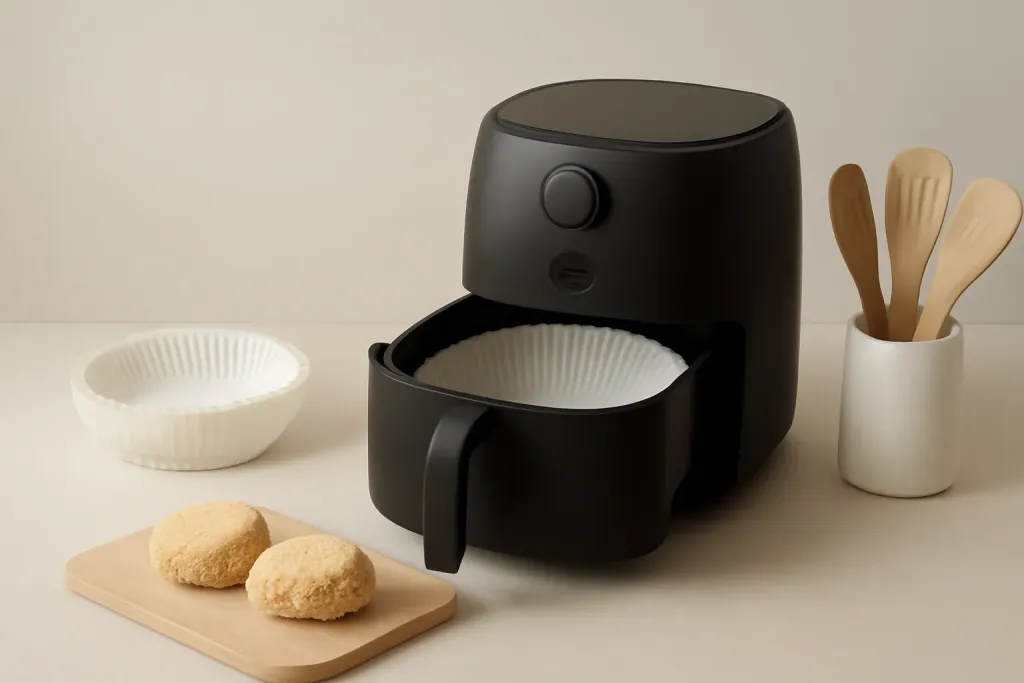
Overview of Air Fryer Liners
Air fryer liners are optional inserts or coverings used to catch crumbs, grease, and sticky drips inside a basket or tray. For shoppers comparing air fryer liners types and tradeoffs, the key question is not whether one liner is always better, but which material fits the appliance, the recipe, and the way you cook.
These accessories are best thought of as convenience tools. They may reduce cleanup, but they can also change how air moves around food if they are too large, too thick, or used in the wrong way. That means fit, ventilation, and the food being cooked matter just as much as the material itself.
Because air fryers depend on circulating hot air, a liner should not block the basket in a way that interferes with cooking. Most manufacturers recommend using accessories only when they fit the basket properly and stay held down by food. In practice, the right liner is usually the one that makes cleanup easier without getting in the way of airflow.
The main categories are disposable parchment, reusable silicone, foil used as a workaround, and some metal inserts or trays designed for certain appliances. Each one has practical strengths and drawbacks. The differences are small on paper, but they matter when you use the appliance often.
Perforated Parchment Liners
Perforated parchment is one of the most common disposable choices. It is usually sold as pre-cut rounds or squares with holes that allow some air movement. For many shoppers, this is the simplest entry point when researching air fryer liners types and tradeoffs because it is familiar, easy to store, and quick to discard after use.
The main advantage is cleanup. Parchment can help keep sticky sauces, breading, and oily residue off the basket surface. That makes it appealing for foods that leave behind baked-on messes, especially when you want to spend less time scrubbing after dinner.
The tradeoff is that parchment is less durable than reusable materials. It can curl, shift, or scorch if it is not weighed down by enough food or if it is used in a basket with strong airflow. For that reason, it works best as a support surface rather than something to place in an empty preheating basket.
Fit matters a lot. A liner that is too large may fold up the sides or drift toward the heating area. One that is too small may not protect much of the basket at all. The goal is a flat liner that stays under the food and does not interfere with circulation.
Parchment is often the easiest all-purpose option, but it is not the best choice for every recipe. It is most useful when convenience and fast cleanup matter more than reusability or a rigid cooking surface.
Silicone Liners and Mats
Silicone liners are reusable inserts sold in basket-style cups, trays, or flat mats. They are a common option for people who want something they can wash and use again instead of throwing away after each meal. For frequent air fryer users, that repeat convenience is often the biggest attraction.
Silicone can help with foods that stick or leave oily residue, and it may be easier to lift food out of the basket than thin paper. Some designs use raised ribs or perforations to leave more space under the food, while flatter designs are simpler but may cover more of the basket surface.
The tradeoff is that silicone is not automatically the best choice for every dish. A thick or poorly vented liner can reduce direct exposure to circulating hot air, which may matter when browning or crisping is the priority. Silicone also needs washing and drying, and some shapes take up more storage space than disposable liners.
Another practical point is odor and residue. Like many reusable kitchen accessories, silicone may hold onto greasy buildup if it is not cleaned promptly. That makes it a better fit for shoppers who want a durable routine accessory and are comfortable with the extra upkeep.
When comparing silicone options, look at thickness, shape, and basket compatibility. A well-fitted silicone liner can be useful, but only if it suits the appliance and does not get in the way of airflow.
Foil and Metal Options
Aluminum foil is often used as a makeshift liner because it is familiar and easy to shape, but it is not the same as a purpose-made air fryer liner. It can catch drips or wrap certain foods, yet it needs to be used carefully because loose foil can shift, crumple, or block airflow if it is not fitted well.
Foil’s biggest advantage is flexibility. It can be molded to odd shapes and is easy to discard after cooking. It may be useful for recipes where you want to contain liquid ingredients or protect the basket from messy drips. The tradeoff is that foil can cover too much of the basket surface if overused, which may make it a weaker choice when crisp texture matters.
Metal accessories are a different category altogether. They are better described as inserts or trays than liners, and they are usually intended for specific appliances or compatible models. Some can help elevate food or organize a batch, but they are not universal and should only be used when they fit the model and clearances properly.
For consumers comparing air fryer liners types and tradeoffs, foil and metal sit at different ends of convenience. Foil is quick and adaptable, but less controlled. Metal is more structured and durable, but less flexible. Neither replaces the need to follow the appliance guidance for fit and use.
Browse our recommended products
Our featured picks refresh periodically. While we update them, our editorial guides can help you find the right pick.
See our guidesPre-Cut Versus Custom-Fit Shapes
Disposable liners are not all the same size or shape. Some come as pre-cut rounds, others as square sheets, and some as folded tray-style inserts. Pre-cut liners are popular because they save time and remove the need to measure or trim. For many households, that simplicity is the main selling point.
Custom-fit shapes can be more practical for unusual basket sizes. If a liner is too small, it may expose too much of the basket. If it is too large, it may curl up the sides, catch on the drawer, or interfere with circulation. A liner that matches the basket more closely is usually easier to use consistently.
The tradeoff is flexibility versus precision. Pre-cut liners are quick and convenient, but they depend on the appliance dimensions matching the pack. Trimmed paper can be adapted to less common shapes, though it takes more effort and may leave rough edges.
For people who use more than one air fryer, or who cook both small and large batches, having different sizes on hand can be more practical than expecting one liner to do everything. In this category, fit matters more than novelty.
Airflow and Usage Basics
The biggest tradeoff across all liner types is airflow versus cleanup. Air fryers are designed to move hot air around food, so anything that covers too much of the basket can affect how evenly the appliance works. A liner should support cooking, not replace the need for proper spacing and food arrangement.
A common mistake is placing a lightweight paper liner in an empty basket during preheating. If it is not held down by food, it can move around and create problems inside the appliance. Conservative guidance is straightforward: use liners only when they stay in place under the food and away from restricted areas.
Grease and moisture also matter. Some liners collect liquid under the food, which may make cleanup easier but can soften the bottom surface of certain recipes. If browning or crisp texture is important, a heavily covered basket may be less suitable than a more open design.
It is also smart to check the manual for model-specific accessory guidance. Basket size, fan placement, and heating-element clearance vary, so a liner that works well in one machine may be a poor fit in another. When in doubt, the more conservative choice is usually the better one.
Choosing by Cooking Style
The best liner depends on the foods you cook most often. For sticky marinades, saucy items, or delicate baked foods, disposable parchment may offer the easiest cleanup. For repeat use and a more structured insert, silicone is often the stronger candidate. For occasional use or unusual shapes, foil may serve as a temporary workaround, though not always as neatly as a purpose-made liner.
If you cook a lot of breaded foods, airflow and release may matter more than extra coverage. In that case, a thin perforated liner can be a better choice than a thick mat. If you often cook oily foods or small items that can fall through the basket, a more structured insert or a silicone cup may help contain the mess.
Batch size matters too. A small liner in a large basket may not protect much, while a large liner in a small basket may reduce airflow or fit poorly. Some households end up using more than one type, because a single liner rarely does every job well.
From an affiliate-shopping standpoint, it is usually smarter to buy for use case, not for novelty. A simple liner that fits your basket and cooking style is often more useful than a feature-heavy option that sounds clever but does not match the way you actually cook.
A Simple Buying Guide
When comparing air fryer liners types and tradeoffs, a short checklist can narrow the field. First, confirm the basket shape and dimensions. Second, decide whether you want disposable convenience or reusable structure. Third, think about the foods you cook most often and whether you care most about cleanup, airflow, or easy handling.
For shoppers who want the least maintenance, perforated parchment is often the easiest place to start. For those who prefer reusable accessories, silicone is the most common alternative. For occasional improvised use, foil can work if handled conservatively and kept clear of restricted areas. Metal inserts belong in a separate category and should be considered only when they are clearly compatible with the appliance.
It also helps to avoid overbuying. A large pack is not a better choice if the size is wrong or the material does not suit your routine. The most useful liner is the one that fits your basket, stays in place, and does not interfere with the food.
In the end, liners are small accessories with meaningful practical differences. The right choice comes down to how you balance cleanup, airflow, and convenience. For many people, that balance may lead to a mix of two types rather than one all-purpose product.